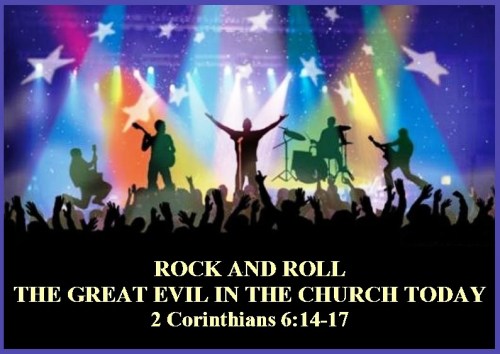
This week, we have came across articles about rock and roll music in the church and feel the urgency to share the danger it presents, with the pastors and lay people that follow our blog. The contents of this writing describe the deceit and evil of entertainment vs. honest, humble worship in the Church.
The great evil in the church today is that they think they are in the entertainment business.
A.W. Tozer believed this already to be true back in the 1950s and 60s. Church members “want to be entertained while they are being edified,” he said this in 1962. Tozer grieved, that it was “hardly possible in most churches to get anyone to attend a meeting where the only attraction was God.”
More recently, David Platt has asked: “What if we take away the rock music and the comfortable chairs? What if the screens are gone and the stage is no longer decorated? What if the air conditioning is off and the comforts are removed? Would His Word and worshiping Christ still be enough for His people to come together?”
Would it be enough?
Tozer got it right: “Deceitful methods and false music is as deadly as deceitful messages.”
HOLY LIVING AND HOLY WORSHIP VERSUS SUPERFICIAL, FALSE WORSHIP
Like Tozer, we should be concerned that so many people in our churches want to be entertained while they worship another god. We should be concerned when people no longer recognize the difference between the holiness and worldliness. And we should be alarmed by the growing belief that adding more entertainment to worship is necessary for the church to accomplish its mission.
We are saddened when we see the so-called cults characterized more by props, performances, with disco atmospheres than by divine sacredness that shows humble, holy respect for God. These people are controlled by phony worship, and influenced emotionally by demons who are from hell and controlled by Satan-inspired deceivers.
Please understand that this is not about worship styles. The issue is not traditional versus contemporary worship. It’s not about organ versus worship band. That kind of discussion misses the point completely. What we are talking about is the focus and intention of worship that comes from the heart. The real issues are these:
- Who or what is the spotlight really on?
If the center of attention focuses more on the human performance than on the gospel of Christ, it is not worship. If anyone other than Jesus is receiving our adoration, it is not our Creator that people are worshiping.
Many churches have started dancing where their whole congregation turns what should be a humble worship service into a disco club performance.
These dancers pretend to be more spiritual with their show, than the honest, humble people who want to worship God in the beauty of His Holiness.
In their pride, these people try to make their dance and gymnastic moves look super spiritual by calling it “Davidic dancing” or “dancing before the Lord.” Some call it Messianic dancing, this title is deceitful and brings great dishonor to our wonderful Creator and Savior. Remember, the Messiah condemned all proud, deceitful religious shows and show offs.
Many people condemn us for bringing this to their attention, they say that times have changed and that we are legalistic, when there is no where in the Bible where dancing is preformed in either the Temple, in the Synagogue or in the New Testament church.
- So what message are we communicating?
The message that the world needs to hear from the church is NOT, “Come and have a good time,” “Come and be entertained,” or “Come and find your best life now.”
Tozer said: “Christ calls men to carry a cross; however, today the church draws people to come and have fun in His name.”
The message of the church is the message of the cross. Lest we forget, Jesus’ cross was a source of entertainment only for those who mocked Him as He hung on it.
Worshiping our Creator God is not about being entertained and getting euphoric. Worship is laying down our lives, honoring the God who died for us, and receiving His grace.
- Are lives really transformed?
Some will say, “But our methods are attracting and winning people!”
Tozer responded to that comment by asking: “Attracting and winning them to what? To true discipleship? To carrying their own cross? To self-denial? To separation from the world? To crucifixion of the flesh? To holy living? To nobility of character? To a despising of the world’s treasures? To self-discipline? To love for God? To total committal to Christ?”
THE WORD DOES THE WORK
David Platt and the church he leads, at McLean Bible Church, decided to try to answer the question, “Is His Word still sufficient for His people to come together?” They eliminated all entertainment and invited people to come simply to study God’s Word and called it Secret Church. They set a date—on a Friday night—when they would gather from 6:00 in the evening until midnight, and for six hours they would do nothing but study God’s Word and pray. People came; a thousand people came the first time and the church grew from then on. Soon, they had to start taking reservations because the church was packed full. Secret Church now draws tens of thousands of people via simulcast in over 50 countries around the world—with no entertainment, or any other distractions.
Why do they come? Platt explained in an interview: “People are hungry for the Word. There’s really nothing special or creative about it. It’s just the study of the Word …. The Word itself does the work!”
People are hungry for a diet that has substance. They want more of the Word; and to delve deeper into its content; and they don’t want what Tozer called “religious nonsense and unimportant matters.”
JUDGMENT IS COMING ON RELIGIOUS ROCK AND ROLL
This is a warning to anyone involved with Satan’s inspired religious rock and roll, which is an abomination to God. By listening to “religious rock and roll” you are harming not only yourself but God’s children as well, who are ignorant to the truth behind this music.
Therefore, we need to be aware of the Lord Jesus’ warnings: “But whoever causes one of these little ones who believe in Me to sin, it would be better for him if a millstone were hung around his neck, and he were drowned in the depth of the sea” (Matthew 18:6).
If you truly love the Lord Jesus and have the Holy Spirit living in you, you will forsake this evil music. If not God will judge those who are rebellious, because He has always judged sin and rebellion in the past, and He is going to do it again; do you want God’s judgment in your life?
The Bible warns: “Now upon you I will soon pour out My fury, and spend My anger upon you; I will judge you according to your ways, and I will repay you for all your abominations. ‘My eye will not spare, nor will I have pity; I will repay you according to your ways, and your abominations will be in your midst. Then you shall know that I am the Lord who strikes” (Ezekiel 7:8-9).
“But when a righteous man turns away from his righteousness and commits iniquity, and does according to all the abominations that the wicked man does, shall he live? All the righteousness which he has done shall not be remembered; because of the unfaithfulness of which he is guilty and the sin which he has committed, because of them he shall die” (Ezekiel 18:24).
“Woe to those who call evil good, and good evil; who put darkness for light, and light for darkness; who put bitter for sweet, and sweet for bitter!” (Isaiah 5:20).
“Do you not know that friendship with the world is enmity with God? Whoever therefore wants to be a friend of the world makes himself an enemy of God” (James 4:4).
As we read these verses, we notice that it’s our choice to obey or rebel.
A WARNING TO PASTORS
“And He (Jesus) said to them, “It is written, ‘My house shall be called a house of prayer,’ but you have made it a ‘den of thieves’” (Matthew 21:13).
This verse has real meaning today in light of “religious rock music”. God’s temple was not intended to become a den of thieves. This verse says: “but you have made it “, referring to the fact that it was the religious leaders that allowed the temple to go from a house of prayer to a den of thieves.
Church leaders and pastors have an awesome responsibility and they will give an account as to how they pastored the church under their care. If the pastor allows foolishness and evil to come in, it will affect God’s people in a negative way by causing a love for the world and carnality.
So if you are not familiar with this passage read it carefully. This I what God said to Ezekiel: “I have made you a watchman for the house of Israel; therefore you shall hear a word from My mouth and warn them for Me. When I say to the wicked, ‘O wicked man, you shall surely die!’ and you do not speak to warn the wicked from his way, that wicked man shall die in his iniquity; but his blood I will require at your hand. Nevertheless if you warn the wicked to turn from his way, and he does not turn from his way, he shall die in his iniquity; but you have delivered your soul” (Ezekiel 33:7-9).
If pastors keep out evil and concentrate on building up God’s people with the Word of God, the church will grow and mature. “Therefore take heed to yourselves and to all the flock, among which the Holy Spirit has made you overseers, to shepherd the church of God which He purchased with His own blood” (Acts 20:28).
The tragedy of the religious rock craze is that this demonic music would never have made it into the churches if pastors and church leaders had obeyed God and closed the door to this evil.
Pastors, when you indulge in ungodly entertainment and compromised living then demonstrate your “freedom” by speaking about it from the pulpit, referencing the latest unclean movie in your “oh-so-cool sermons”; you are causing damage on those whom Jesus has cleansed, encouraging them to follow in your footsteps and going even further. Remember the verse we have already used. “But whoever causes one of these little ones who believe in Me to sin, it would be better for him if a millstone were hung around his neck, and he were drowned in the depth of the sea” (Matthew 18:6).
For those pastors and church leaders that take their job lightly and are not committed to building up and protecting God’s church should repent and remember that “we must all appear before the judgment seat of Christ, that each one may receive the things done in the body, according to what he has done, whether good or bad” (2 Corinthians 5:10). And if you do not repent you will have to appear before the Great White Throne Judgment and you will be cast into the Lake of Fire forever.
To the sheep who are being misled, we urge you in the fear of the Lord; run for your lives and get into a church where the Word of God is being taught and true worship exists. Study and get familiar with the Word, and don’t let yourself be deceived by every doctrine, by the trickery of men, in the cunning craftiness of deceitful plotting (Ephesians 4:14).
It is the pastor’s duty to review what kind of music is allowed in a God fearing church. Therefore we say to godly leaders, be strong and be faithful.
HERE ARE SOME DANGEROUS WAYS OF THINKING
ARGUMENT #1 – Christian rock can’t be wrong. Look at all the people who get the message during these religious rock and roll concerts. Look at how popular God has made these bands.
ANSWER: So-called results do not mean God is behind it. The Lord Jesus said, “Beware of false prophets, who come to you in sheep’s clothing, but inwardly they are ravenous wolves” (Matthew 7:15).
And He continues “Not everyone who says to Me, ‘Lord, Lord,’ shall enter the kingdom of heaven, but he who does the will of My Father in heaven. Many will say to Me in that day, ‘Lord, Lord, have we not prophesied in Your name, cast out demons in Your name, and done many wonders in Your name?’ And then I will declare to them, ‘I never knew you; depart from Me, you who practice lawlessness!’” (Matthew 7:21-23)
The Lord Jesus also said that many will be deceived by false prophets and false christs. “Then many false prophets will rise up and deceive many. And because lawlessness will abound, the love of many will grow cold…..for false christs and false prophets will rise and show great signs and wonders to deceive, if possible, even the elect” (Matthew 24:11-12, 24).
ARGUMENT #2 – We have to use Rock Music because this is the only way the youth of this generation can be reached.
ANSWER – We are told by the religious rockers that we must look and sound like the world in order to reach the youth of this generation. They say, many young people will not listen to the gospel or come to church so we must meet them on some common ground. That common ground is rock and roll. In other words, they are saying that preaching from the Word of God is no longer sufficient for both young and old.
If this is true, then we should open bars in order to reach the multitudes of drinkers. We should open porno-shops in order to reach those who engage in this abomination. Shouldn’t we go to their level so we can bring them to the Lord Jesus Christ? So, what does it matter if we do wrong, if the end result is good? What does a slight deviation from God’s standards of holiness matter if it results in the salvation of souls?
This type of reasoning is one of the doctrines of demons that Christians are accepting. Does it not make sense that the Bible that has worked successfully throughout the centuries, will continue to work for both the young and the old? How many Christians that love God’s people would be courageous to say, “Enough, no more! Throw this satanic filth out of the church and back into hell where it belongs?”
Do you understand that just a few years ago this evil music would not have even remotely been considered as a suitable method to sing and praise God? That type of music would have been immediately thrown out of the churches. What we are witnessing today is the spiritual and moral degeneration that is affecting Christians to the degree that many no longer have any discernment between good and evil.
In case you did not know, the term “rock and roll” means fornication. It is a street name for sexual immorality. It has wrecked the lives of many teenagers through suicide, drug abuse, immorality, perversion, Satanism, etc.
Sadly, we live in a time where many Christians and church leaders are allowing this demonic music into their churches, claiming that the music is holy and sanctified because the lyrics are changed to include some ‘religious’ words. Where is the discernment in the church? Are Christians losing their ability to discern the difference between good and evil? The fact that this demonic music even made it into the church is proof of the moral and spiritual decline affecting the church today.
The Bible tells us: “Do not be unequally yoked together with unbelievers. For what fellowship has righteousness with lawlessness? And what communion has light with darkness? And what accord has Christ with Belial? Or what part has a believer with an unbeliever? And what agreement has the temple of God with idols? For you are the temple of the living God . . . Therefore “come out from among them and be separate, says the Lord. Do not touch what is unclean, and I will receive you” (2 Corinthians 6:14-17).
Most importantly, the Word of God does not say we are to go out and acquire the evil ways of the world but on the contrary, we are commanded to come out and separate ourselves from evil.
WARNING TO EVERYONE
Today we have “churches” playing: Christian Rock, Christian New Wave, Christian Heavy Metal, Christian Punk and Christian Rap to name a few. What are they going to come up with next?
Please become aware that “Christian Rock” or any variety thereof is destructive to the Church as it leads God’s people into sensuality and to compromise God’s Word. If you sincerely love the Lord Jesus Christ and you are involved with this kind of music, then obey the Lord and forsake it, unless you are a part of those who “profess to know God, but in works deny Him, being abominable, disobedient, and disqualified for every good work” (Titus 1:16).
Our mission is to bring God glory and honor through our words, actions, and our commitment to serving others and to making disciples. As Jesus said: “‘You shall love the Lord your God with all your heart, with all your soul, and with all your mind.’ This is the first and great commandment. And the second is like it: ‘You shall love your neighbor as yourself’” (Matthew 22:37-39).
The kind of worship that God desires happens outside of the walls of a church that employs a rock and roll performance. True worship it is about obedience, discipleship and expressing our admiration for God’s holiness that brings Him honor and glory every day of our life.
*******









This week, we have came across articles about rock and roll music in the church and feel the urgency to share the danger it presents, with the pastors and lay people that follow our blog. The contents of this writing describe the deceit and evil of entertainment vs. honest, humble worship in the Church.
The great evil in the church today is that they think they are in the entertainment business.
A.W. Tozer believed this already to be true back in the 1950s and 60s. Church members “want to be entertained while they are being edified,” he said this in 1962. Tozer grieved, that it was “hardly possible in most churches to get anyone to attend a meeting where the only attraction was God.”
More recently, David Platt has asked: “What if we take away the rock music and the comfortable chairs? What if the screens are gone and the stage is no longer decorated? What if the air conditioning is off and the comforts are removed? Would His Word and worshiping Christ still be enough for His people to come together?”
Would it be enough?
Tozer got it right: “Deceitful methods and false music is as deadly as deceitful messages.”
HOLY LIVING AND HOLY WORSHIP VERSUS SUPERFICIAL, FALSE WORSHIP
Like Tozer, we should be concerned that so many people in our churches want to be entertained while they worship another god. We should be concerned when people no longer recognize the difference between the holiness and worldliness. And we should be alarmed by the growing belief that adding more entertainment to worship is necessary for the church to accomplish its mission.
We are saddened when we see the so-called cults characterized more by props, performances, with disco atmospheres than by divine sacredness that shows humble, holy respect for God. These people are controlled by phony worship, and influenced emotionally by demons who are from hell and controlled by Satan-inspired deceivers.
Please understand that this is not about worship styles. The issue is not traditional versus contemporary worship. It’s not about organ versus worship band. That kind of discussion misses the point completely. What we are talking about is the focus and intention of worship that comes from the heart. The real issues are these:
If the center of attention focuses more on the human performance than on the gospel of Christ, it is not worship. If anyone other than Jesus is receiving our adoration, it is not our Creator that people are worshiping.
Many churches have started dancing where their whole congregation turns what should be a humble worship service into a disco club performance.
These dancers pretend to be more spiritual with their show, than the honest, humble people who want to worship God in the beauty of His Holiness.
In their pride, these people try to make their dance and gymnastic moves look super spiritual by calling it “Davidic dancing” or “dancing before the Lord.” Some call it Messianic dancing, this title is deceitful and brings great dishonor to our wonderful Creator and Savior. Remember, the Messiah condemned all proud, deceitful religious shows and show offs.
Many people condemn us for bringing this to their attention, they say that times have changed and that we are legalistic, when there is no where in the Bible where dancing is preformed in either the Temple, in the Synagogue or in the New Testament church.
The message that the world needs to hear from the church is NOT, “Come and have a good time,” “Come and be entertained,” or “Come and find your best life now.”
Tozer said: “Christ calls men to carry a cross; however, today the church draws people to come and have fun in His name.”
The message of the church is the message of the cross. Lest we forget, Jesus’ cross was a source of entertainment only for those who mocked Him as He hung on it.
Worshiping our Creator God is not about being entertained and getting euphoric. Worship is laying down our lives, honoring the God who died for us, and receiving His grace.
Some will say, “But our methods are attracting and winning people!”
Tozer responded to that comment by asking: “Attracting and winning them to what? To true discipleship? To carrying their own cross? To self-denial? To separation from the world? To crucifixion of the flesh? To holy living? To nobility of character? To a despising of the world’s treasures? To self-discipline? To love for God? To total committal to Christ?”
THE WORD DOES THE WORK
David Platt and the church he leads, at McLean Bible Church, decided to try to answer the question, “Is His Word still sufficient for His people to come together?” They eliminated all entertainment and invited people to come simply to study God’s Word and called it Secret Church. They set a date—on a Friday night—when they would gather from 6:00 in the evening until midnight, and for six hours they would do nothing but study God’s Word and pray. People came; a thousand people came the first time and the church grew from then on. Soon, they had to start taking reservations because the church was packed full. Secret Church now draws tens of thousands of people via simulcast in over 50 countries around the world—with no entertainment, or any other distractions.
Why do they come? Platt explained in an interview: “People are hungry for the Word. There’s really nothing special or creative about it. It’s just the study of the Word …. The Word itself does the work!”
People are hungry for a diet that has substance. They want more of the Word; and to delve deeper into its content; and they don’t want what Tozer called “religious nonsense and unimportant matters.”
JUDGMENT IS COMING ON RELIGIOUS ROCK AND ROLL
This is a warning to anyone involved with Satan’s inspired religious rock and roll, which is an abomination to God. By listening to “religious rock and roll” you are harming not only yourself but God’s children as well, who are ignorant to the truth behind this music.
Therefore, we need to be aware of the Lord Jesus’ warnings: “But whoever causes one of these little ones who believe in Me to sin, it would be better for him if a millstone were hung around his neck, and he were drowned in the depth of the sea” (Matthew 18:6).
If you truly love the Lord Jesus and have the Holy Spirit living in you, you will forsake this evil music. If not God will judge those who are rebellious, because He has always judged sin and rebellion in the past, and He is going to do it again; do you want God’s judgment in your life?
The Bible warns: “Now upon you I will soon pour out My fury, and spend My anger upon you; I will judge you according to your ways, and I will repay you for all your abominations. ‘My eye will not spare, nor will I have pity; I will repay you according to your ways, and your abominations will be in your midst. Then you shall know that I am the Lord who strikes” (Ezekiel 7:8-9).
“But when a righteous man turns away from his righteousness and commits iniquity, and does according to all the abominations that the wicked man does, shall he live? All the righteousness which he has done shall not be remembered; because of the unfaithfulness of which he is guilty and the sin which he has committed, because of them he shall die” (Ezekiel 18:24).
“Woe to those who call evil good, and good evil; who put darkness for light, and light for darkness; who put bitter for sweet, and sweet for bitter!” (Isaiah 5:20).
“Do you not know that friendship with the world is enmity with God? Whoever therefore wants to be a friend of the world makes himself an enemy of God” (James 4:4).
As we read these verses, we notice that it’s our choice to obey or rebel.
A WARNING TO PASTORS
“And He (Jesus) said to them, “It is written, ‘My house shall be called a house of prayer,’ but you have made it a ‘den of thieves’” (Matthew 21:13).
This verse has real meaning today in light of “religious rock music”. God’s temple was not intended to become a den of thieves. This verse says: “but you have made it “, referring to the fact that it was the religious leaders that allowed the temple to go from a house of prayer to a den of thieves.
Church leaders and pastors have an awesome responsibility and they will give an account as to how they pastored the church under their care. If the pastor allows foolishness and evil to come in, it will affect God’s people in a negative way by causing a love for the world and carnality.
So if you are not familiar with this passage read it carefully. This I what God said to Ezekiel: “I have made you a watchman for the house of Israel; therefore you shall hear a word from My mouth and warn them for Me. When I say to the wicked, ‘O wicked man, you shall surely die!’ and you do not speak to warn the wicked from his way, that wicked man shall die in his iniquity; but his blood I will require at your hand. Nevertheless if you warn the wicked to turn from his way, and he does not turn from his way, he shall die in his iniquity; but you have delivered your soul” (Ezekiel 33:7-9).
If pastors keep out evil and concentrate on building up God’s people with the Word of God, the church will grow and mature. “Therefore take heed to yourselves and to all the flock, among which the Holy Spirit has made you overseers, to shepherd the church of God which He purchased with His own blood” (Acts 20:28).
The tragedy of the religious rock craze is that this demonic music would never have made it into the churches if pastors and church leaders had obeyed God and closed the door to this evil.
Pastors, when you indulge in ungodly entertainment and compromised living then demonstrate your “freedom” by speaking about it from the pulpit, referencing the latest unclean movie in your “oh-so-cool sermons”; you are causing damage on those whom Jesus has cleansed, encouraging them to follow in your footsteps and going even further. Remember the verse we have already used. “But whoever causes one of these little ones who believe in Me to sin, it would be better for him if a millstone were hung around his neck, and he were drowned in the depth of the sea” (Matthew 18:6).
For those pastors and church leaders that take their job lightly and are not committed to building up and protecting God’s church should repent and remember that “we must all appear before the judgment seat of Christ, that each one may receive the things done in the body, according to what he has done, whether good or bad” (2 Corinthians 5:10). And if you do not repent you will have to appear before the Great White Throne Judgment and you will be cast into the Lake of Fire forever.
To the sheep who are being misled, we urge you in the fear of the Lord; run for your lives and get into a church where the Word of God is being taught and true worship exists. Study and get familiar with the Word, and don’t let yourself be deceived by every doctrine, by the trickery of men, in the cunning craftiness of deceitful plotting (Ephesians 4:14).
It is the pastor’s duty to review what kind of music is allowed in a God fearing church. Therefore we say to godly leaders, be strong and be faithful.
HERE ARE SOME DANGEROUS WAYS OF THINKING
ARGUMENT #1 – Christian rock can’t be wrong. Look at all the people who get the message during these religious rock and roll concerts. Look at how popular God has made these bands.
ANSWER: So-called results do not mean God is behind it. The Lord Jesus said, “Beware of false prophets, who come to you in sheep’s clothing, but inwardly they are ravenous wolves” (Matthew 7:15).
And He continues “Not everyone who says to Me, ‘Lord, Lord,’ shall enter the kingdom of heaven, but he who does the will of My Father in heaven. Many will say to Me in that day, ‘Lord, Lord, have we not prophesied in Your name, cast out demons in Your name, and done many wonders in Your name?’ And then I will declare to them, ‘I never knew you; depart from Me, you who practice lawlessness!’” (Matthew 7:21-23)
The Lord Jesus also said that many will be deceived by false prophets and false christs. “Then many false prophets will rise up and deceive many. And because lawlessness will abound, the love of many will grow cold…..for false christs and false prophets will rise and show great signs and wonders to deceive, if possible, even the elect” (Matthew 24:11-12, 24).
ARGUMENT #2 – We have to use Rock Music because this is the only way the youth of this generation can be reached.
ANSWER – We are told by the religious rockers that we must look and sound like the world in order to reach the youth of this generation. They say, many young people will not listen to the gospel or come to church so we must meet them on some common ground. That common ground is rock and roll. In other words, they are saying that preaching from the Word of God is no longer sufficient for both young and old.
If this is true, then we should open bars in order to reach the multitudes of drinkers. We should open porno-shops in order to reach those who engage in this abomination. Shouldn’t we go to their level so we can bring them to the Lord Jesus Christ? So, what does it matter if we do wrong, if the end result is good? What does a slight deviation from God’s standards of holiness matter if it results in the salvation of souls?
This type of reasoning is one of the doctrines of demons that Christians are accepting. Does it not make sense that the Bible that has worked successfully throughout the centuries, will continue to work for both the young and the old? How many Christians that love God’s people would be courageous to say, “Enough, no more! Throw this satanic filth out of the church and back into hell where it belongs?”
Do you understand that just a few years ago this evil music would not have even remotely been considered as a suitable method to sing and praise God? That type of music would have been immediately thrown out of the churches. What we are witnessing today is the spiritual and moral degeneration that is affecting Christians to the degree that many no longer have any discernment between good and evil.
In case you did not know, the term “rock and roll” means fornication. It is a street name for sexual immorality. It has wrecked the lives of many teenagers through suicide, drug abuse, immorality, perversion, Satanism, etc.
Sadly, we live in a time where many Christians and church leaders are allowing this demonic music into their churches, claiming that the music is holy and sanctified because the lyrics are changed to include some ‘religious’ words. Where is the discernment in the church? Are Christians losing their ability to discern the difference between good and evil? The fact that this demonic music even made it into the church is proof of the moral and spiritual decline affecting the church today.
The Bible tells us: “Do not be unequally yoked together with unbelievers. For what fellowship has righteousness with lawlessness? And what communion has light with darkness? And what accord has Christ with Belial? Or what part has a believer with an unbeliever? And what agreement has the temple of God with idols? For you are the temple of the living God . . . Therefore “come out from among them and be separate, says the Lord. Do not touch what is unclean, and I will receive you” (2 Corinthians 6:14-17).
Most importantly, the Word of God does not say we are to go out and acquire the evil ways of the world but on the contrary, we are commanded to come out and separate ourselves from evil.
WARNING TO EVERYONE
Today we have “churches” playing: Christian Rock, Christian New Wave, Christian Heavy Metal, Christian Punk and Christian Rap to name a few. What are they going to come up with next?
Please become aware that “Christian Rock” or any variety thereof is destructive to the Church as it leads God’s people into sensuality and to compromise God’s Word. If you sincerely love the Lord Jesus Christ and you are involved with this kind of music, then obey the Lord and forsake it, unless you are a part of those who “profess to know God, but in works deny Him, being abominable, disobedient, and disqualified for every good work” (Titus 1:16).
Our mission is to bring God glory and honor through our words, actions, and our commitment to serving others and to making disciples. As Jesus said: “‘You shall love the Lord your God with all your heart, with all your soul, and with all your mind.’ This is the first and great commandment. And the second is like it: ‘You shall love your neighbor as yourself’” (Matthew 22:37-39).
The kind of worship that God desires happens outside of the walls of a church that employs a rock and roll performance. True worship it is about obedience, discipleship and expressing our admiration for God’s holiness that brings Him honor and glory every day of our life.
*******
2 Comments
Posted in 2 Corinthians 6:14-17, ROCK AND ROLL – THE GREAT EVIL IN THE CHURCH TODAY – 2 Corinthians 6:14-17 | Tags: 2 Corinthians 5:10, 2 Corinthians 6:14-17, Acts 20:28, Ephesians 4:14, Ezekiel 18:24, Ezekiel 33:7-9, Ezekiel 7:8-9, Isaiah 5:20, James 4:4, Matthew 18:6, Matthew 21:13, Matthew 24:11-12, Matthew 24:24, Matthew 7:15, Matthew 7:21-23, ROCK AND ROLL – THE GREAT EVIL IN THE CHURCH TODAY – 2 Corinthians 6:14-17, Titus 1:16 | Leave a comment