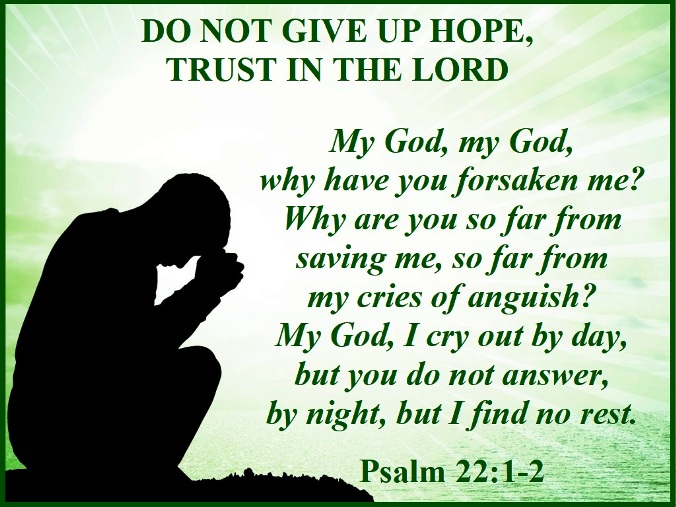
My God, my God, why have you forsaken me? Why are you so far from saving me, so far from my cries of anguish? My God, I cry out by day, but you do not answer, by night, but I find no rest. (Psalm 22:1-2)
In this psalm, David cries out to God for help but feels forsaken and in deep agony because God does not answer him. He expresses utter hopelessness and despair and cannot comprehend why God has abandoned him. He is suffering both physically (Psalm 22:14–15) and socially (verses 6–8). Most disturbing to him is his apparent abandonment by God; since David’s lifelong relationship with God appears to be broken.
Yet even in his desolation, David prays, “My God, my God,” acknowledging his faith in God and dependence on Him, despite the Lord’s apparent distance and silence.
After his first words of despair, David declares outright his trust in the Lord: “Yet you are enthroned as the Holy One; you are the one Israel praises. In you our ancestors put their trust; they trusted and you delivered them. To you they cried out and were saved; in you they trusted and were not put to shame” (Psalm 22:3-5).
David knows that God never forsakes His people: “I will declare your name to my people; in the assembly I will praise You. You, who fear the Lord, praise Him! All you descendants of Jacob honor Him! Revere Him, all you descendants of Israel! For He has not despised or scorned the suffering of the afflicted one; He has not hidden His face from him but has listened to his cry for help” (Psalm 22:22–24).
Hundreds of years in the future, Jesus was nailed on the cross, enduring His most intense moments of torment. He desperately needed His Father’s presence. In a loud voice, the Lord cried out what the psalmist had written in the Messianic prophecy, “Eli, Eli, lama sabachthani?” that is, “My God, My God, why have You forsaken Me?” (Matthew 27:46).
When He was hanging on the cross, Christ recited Psalm 22:1. Joining with the multitude of humans in their affliction, Jesus became one with them in their suffering and cried out to God for help.
This psalm was written to give individuals a model for praying in times of extreme suffering and need. Like so many other psalms, it movingly expresses the common emotional experience of people who feel alone and afflicted.
Our fully God, fully human Savior identifies with us in every way, even in our weakest moments; even when we feel like God has abandoned us. Through Christ’s total identification with us, He gives us His own example of how to pour out our hearts to God. Jesus shows us that trusting God means talking to Him in good and bad times and that we have to especially trust in Him with our worst moments in life.
Hebrew tells us that: “During the days of Jesus’ life on earth, He offered up prayers and petitions with fervent cries and tears to the one who could save Him from death, and He was heard because of His reverent submission” (Hebrews 5:7). Jesus asked that the cup be taken away from Him (Luke 22:42), yet the cup was not taken away. Nevertheless, His prayer was heard because His prayer was not to escape His Father’s will, but to accept it, and that prayer was definitely heard.
Sometimes we have to go thru trying times before we can clearly see our own rebellion and pride that the Lord is trying to show us. When we suffer, we may feel isolated from God, but the reality is that God is with us step-by-step and is trying to teach us what in that moment or circumstance we cannot see.
The Bible teaches us that we are going to suffer in many different ways. And when we suffer, we should remember that:
- If we are faithful, we know that God is present, even when He seems far away;
- God’s timing is perfect, even when He appears not to hear; and
- During our times of suffering, the most important thing to do is keep our faith and trust in God.
Scripture tells us to: “Trust in the Lord with all your heart and lean not on your own understanding; in all your ways submit to Him, and He will make your paths straight” (Proverbs 3:5-6).
As Jesus took on Himself the sins of all humankind, He acknowledged feeling abandoned by the Father, yet, like David, He trusted in God. He knew that He was fulfilling God’s purpose by laying down His life: “God made Him who had no sin to be sin for us, so that in Him we might become the righteousness of God” (2 Corinthians 5:21).
Therefore, the greatest mistake any Christian can make is to substitute his own will for the will of God.
If you are having problems hearing from the Lord, consider this verse: “If I regard iniquity in my heart, the Lord will not hear me” (Psalm 66:18).
Then read 1 John 1:9: “If we confess our sins, he is faithful and just and will forgive us our sins and purify us from all unrighteousness.”
And to help you further, memorize the following verses:
“You keep him in perfect peace whose mind is fixed on You, because he trusts in You.” (Isaiah 26:3)
“Do not fear, for I am with you; do not be dismayed, for I am your God. I will strengthen you and help you; I will uphold you with my righteous right hand.” (Isaiah 41:10)
“Those who know Your name will put their trust in You; for You, Lord, have not forsaken those who seek You.” (Psalm 9:10)
May the God of hope bless you!
“Now may the God of hope fill you with all joy and peace in believing,
that you may abound in hope by the power of the Holy Spirit.”
Romans 15:13
*******



Leave a comment