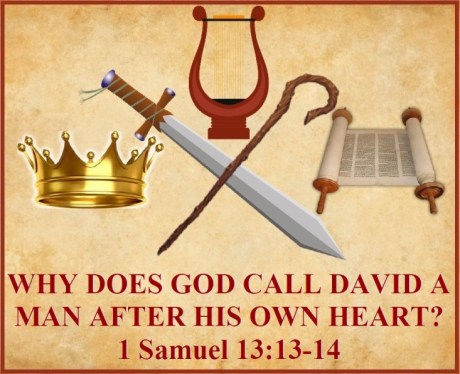
And Samuel said to Saul, “You have done foolishly. You have not kept the commandment of the Lord your God, which He commanded you. For now the Lord would have established your kingdom over Israel forever. But now your kingdom shall not continue. The Lord has sought for Himself a man after His own heart, and the Lord has commanded him to be commander over His people, because you have not kept what the Lord commanded you.” (1 Samuel 13:13-14)
The time came when Israel demanded a king (1 Samuel 8:4-5). They desired to be like the other nations and God gave them the king of their choice. In contrast, after Saul had disobeyed God’s command by unlawfully sacrificing, Samuel related that God would now pick “a man after His own heart,” meaning, the choice would be of the Almighty of who would be the next king.
To understand why David was a man after God’s own heart, we need to look at the characteristics he had to qualify for such a high-ranking position.
In the book of Acts, the apostle Paul writes: “And when He had removed him (Saul), He raised up for them David as king, to whom also He gave testimony and said, ‘I have found David the son of Jesse, a man after My own heart, who will do all My will’” (Acts 13:22).
The answer to why David was considered a man after God’s own heart is as the Lord stated, a man…who will do all My will. Today, however, knowing the biblical account of David’s life, we might ask what being a man after God’s heart means, when David committed terrible sins, including adultery and murder?
One of the reasons why David is called a man after God’s own heart is that he had absolute faith in God. Nowhere in Scripture is this point better illustrated than when David as a young shepherd boy fearlessly slew the Philistine, Goliath. Shortly before the combat, we see direct evidence of David’s faith when David says, “The Lord, who delivered me from the paw of the lion and from the paw of the bear, He will deliver me from the hand of this Philistine” (1 Samuel 17:37).
David knew early on in life that God was to be trusted and obeyed. David’s faith pleased God and God rewarded David for his faithfulness. We see a great example of his reverence and obedience to God when we read the account of Saul entering the cave where David and his men were staying in the recesses of the cave and could have taken his life. Then the men of David said to him, “This is the day of which the Lord said to you, ‘Behold, I will deliver your enemy into your hand, that you may do to him as it seems good to you.’ ” And David arose and secretly cut off a corner of Saul’s robe. Now it happened afterward that David’s heart troubled him because he had cut Saul’s robe. And he said to his men, “The Lord forbid that I should do this thing to my master, the Lord’s anointed, to stretch out my hand against him, seeing he is the anointed of the Lord.” So David restrained his servants with these words, and did not allow them to rise against Saul.” (1 Samuel 24:4-7).
David repeatedly mentions how much he love God’s perfect Word in the Psalms, of which he is credited for writing over half of them.
In the following verse we see David’s complete adoration for God’s Word and how he meditates on God’s statutes which granted him understanding and wisdom. “And I will delight myself in Your commandments, which I love. My hands also I will lift up to Your commandments, which I love, and I will meditate on Your statutes” (Psalm 119:47-48).
We should likewise focus on what the Word says as David writes that “Blessed are those who keep His testimonies, who seek Him with the whole heart! (Psalm 119:2).
Even in his sin, David is receptive to Nathan’s confrontation (2 Samuel 12), and is truly repentant and acknowledges his sin in verse 13. David’s sin with Bathsheba included adultery, lying, and murder and is recorded in 2 Samuel 11.
We need to understand that admitting our sin and asking for forgiveness is only half of the equation. The other half is repentance, and David did that as well. In Psalm 51 we read his prayer of repentance to God: “Have mercy upon me, O God, according to Your loving-kindness; according to the multitude of Your tender mercies, blot out my transgressions. Wash me thoroughly from my iniquity, and cleanse me from my sin. For I acknowledge my transgressions, and my sin is always before me. Against You, You only, have I sinned, and done this evil in Your sight—that You may be found just when You speak, and blameless when You judge” (Psalm 51:1-4).
And in Psalm 25:11 we again see where David acknowledges his sins “For Your name’s sake, O Lord, Pardon my iniquity, for it is great.”
We learn much of David’s character in the book of Psalms as he opened up his life for all to study. David’s life was a picture of success and failure and the biblical record highlights the fact that David was far from perfect. But what made David special in the eyes of God was that his heart was always seeking the Lord.
David was a man after God’s own heart also because he was always truly thankful as we read in Psalm 100, “Make a joyful shout to the Lord, all you lands! Serve the Lord with gladness; come before His presence with singing. Know that the Lord, He is God; it is He who has made us, and not we ourselves; we are His people and the sheep of His pasture. Enter into His gates with thanksgiving, and into His courts with praise. Be thankful to Him, and bless His name. For the Lord is good; His mercy is everlasting, and His truth endures to all generations.”
These thoughts and attitudes should be in the heart of every believer and we would do well to follow David’s lead of offering praise through thanksgiving to our Lord.
In summary, David was a man after God’s own heart because he demonstrated his faith and was committed to following the Lord. Yes, his faith was tested on a grand scale, and he failed several times. But after sinning he always sought and received the Lord’s forgiveness. In the final analysis, David loved God’s Law and sought to follow it faithfully.
He also longed to be with the Lord as we see in Psalm 27:4, “One thing I have desired of the Lord, that will I seek: That I may dwell in the house of the Lord all the days of my life, to behold the beauty of the Lord, and to inquire in His temple.”
David is a great example for those who have gone astray and come back to the Lord because we have a merciful God that will forgive us if we truly repent and seek Him (1 John 1:9).
Please understand that he only way for us to enjoy the blessings of a pure heart is to trust in the Lord for our eternal salvation; and as a result He creates in us a pure heart filled with His desires.
Scripture tells us that David was called a “man after God’s own heart” long before he sexually sinned with Bathsheba. This tells us that God is not only the creator of clean hearts, but He is also the restorer and repairer of erring hearts.
Therefore just like David we should worship our heavenly Father by declaring: “Bless the Lord, O my soul; and all that is within me, bless His holy name! Bless the Lord, O my soul, and forget not all His benefits: Who forgives all your iniquities, Who heals all your diseases, Who redeems your life from destruction, Who crowns you with loving-kindness and tender mercies, Who satisfies your mouth with good things…” (Psalm 103:1-5).
*******



Leave a comment