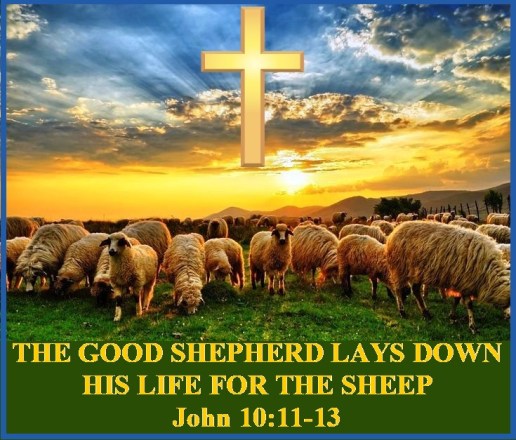
“I am the good shepherd. The good shepherd lays down his life for the sheep. The hired hand is not the shepherd and does not own the sheep. So when he sees the wolf coming, he abandons the sheep and runs away. Then the wolf attacks the flock and scatters it. The man runs away because he is a hired hand and cares nothing for the sheep.” (John 10:11-13)
This is the fourth “I am” declaration recorded in the Gospel of John and points to His unique, divine identity and purpose. We read where Jesus declared Himself “I am the door” in John 10:7 and now Jesus states “I am the good Shepherd.”
It should be understood that Jesus is “the” good Shepherd, not simply “a” good shepherd, as others may be, but He is unique in character as seen in these verses (Psalm 23; Hebrews 13:20; 1 Peter 2:25; 1 Peter 5:4).
Our Lord identifies Himself as the “Good Shepherd,” contrasting Himself with those shepherds of Israel who are rebuked by the Lord in Ezekiel, where he indicts the wicked “shepherds of Israel” who care for themselves at the expense of the flock. They prey upon the sheep rather than protecting them from predators. They feed and clothe themselves at the expense of the flock, yet they do nothing to minister to the needs of the sick or injured among the flock (Ezekiel 34:3-4). It is not difficult to see that Jesus looks upon the Pharisees before Him as the kind of shepherds Ezekiel condemned.
Jesus uses this familiar scene to demonstrate how He is Israel’s true Shepherd and how the Pharisees and other Jewish leaders are evil shepherds. Evil shepherds, to whom Jesus refers as “thieves and robbers,” do not dare present themselves to the doorkeeper, because he will know them for what they are, and will not grant them access to the sheep, since their intent is to steal sheep and to kill them. If they are to gain entrance into the sheepfold, they must enter by some other way than through the door. They must climb over the wall. The way these folks seek to get to the sheep makes it clear that they have no good in mind. The true shepherd enters the sheepfold in a way that demonstrates his claim to his sheep is legitimate. He comes to the doorkeeper, who recognizes him and grants him access through the door to the sheep.
There are many who have claimed to be “shepherds” of God’s flock, but who most certainly were not. Included would be the Pharisees and other Jewish leaders who were currently opposing Jesus. This also refers to those false shepherds yet to appear (Matthew 24:11, 22-28). Whether in the past, present, or future, all false shepherds are alike in that they use and abuse the sheep for their own selfish interests, and they attempt to gain access and leadership in a way that seeks to avoid the divinely approved boundaries. Simply put, they don’t meet the job description of a true shepherd, as described in Ezekiel 34:11-31 and elsewhere.
The so called shepherds promise sheep “the good life,” but they most certainly do not provide it. It is our Lord who is the Good Shepherd, and as such He alone gives salvation, safety, and the abundant life. There is not only an abundance for the sheep here, but a freedom; they can “come in and go out, and find pasture” (John 10:9). This does not mean that they can go their own way, but the Good Shepherd goes before His flock, and His sheep willingly follow Him.
In contrast, a hired hand works with the sheep, but he is not a shepherd; he works for money, in this case he feels no love or devotion to the sheep. Sadly, the hired hand does not have a personal interest in the sheep because they do not belong to him; he tends the sheep, but he is not affectionately attached to them. The hired hand will not risk his life for the sheep because when he sees the wolf coming, he forsakes the sheep and runs for his life; he flees because he does not care about the sheep leaving them to be scattered or killed. In contrast to the hired hand, Jesus declares that as the Good Shepherd, He cares for the sheep, so much so that He willingly lays down His life for them.
Jesus is making a contrast between Himself and the religious leaders, the Pharisees (John 10:12–13) and compares them to a “hireling” or “hired hand” that doesn’t really care about the sheep.
To better understand the purpose of a shepherd during the times of Jesus, it is helpful to realize that sheep are utterly defenseless and totally dependent upon the shepherd. Sheep are always subject to danger and must always be under the watchful eye of the shepherd as they graze because robbers may steal them, and wolves may attack the flock. David tells how he killed a lion and a bear while defending his father’s flock as a shepherd boy (1 Samuel 17:36). Shepherds were frequently subjected to grave danger, sometimes even giving their lives to protect their sheep.
Likewise, Jesus gave His life on the cross as “the Good Shepherd,” as Matthew 20:28 states: “The Son of Man did not come to be served, but to serve, and to give His life a ransom for many.” Through Jesus’ willing sacrifice, the Lord made salvation possible for all who come to Him in faith. In proclaiming that He is the Good Shepherd, Jesus speaks of “laying down” His life for His sheep (John 10:15, 17-18).
Jesus’ death was divinely appointed. It is only through Him that we receive salvation. “I am the good shepherd; and I know My sheep, and am known by My own” (John 10:14). Furthermore, Jesus makes it clear that it wasn’t just for the Jews that he laid down His life, but also for the “other sheep I have which are not of this fold; them also I must bring, and they will hear My voice; and there will be one flock and one shepherd” (John 10:16). The “other sheep” clearly refers to the Gentiles. As a result, Jesus is the Good Shepherd over all, both Jew and Gentile, who come to believe on Him (John 3:16).
Those sheep that pass through the door; that trust in Jesus as God’s Messiah, the Good Shepherd, are those who are saved, and who enter into the abundant life. In “sheep terms,” they enjoy the safety of the shepherd’s care and protection, and the abundance of the rich pastures and water to which He leads them. In “people terms,” those who trust in Jesus are forgiven of their sins and enter into the abundant life, under the protection, guidance, and tender care of the Savior, who is their “Good Shepherd.”
*******



Leave a comment