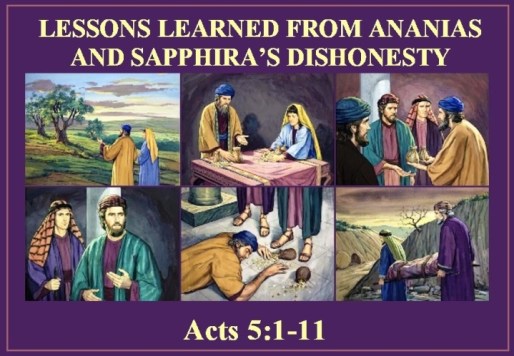
Now a man named Ananias, together with his wife Sapphira, also sold a piece of property. With his wife’s full knowledge he kept back part of the money for himself, but brought the rest and put it at the apostles’ feet. (Acts 5:1-2)
In the early Christian church in Jerusalem, the believers were very close and very caring, to the point that they sold their excess land or possessions and donated the money so no one would go hungry. This sharing of resources was not a requirement of the church, but those who participated were looked upon favorably. Their generosity was a sign of their love for one another. Barnabas was one such generous person in the early church (Acts 4:36).
Believers were one in heart and mind and realized that everything they had was from God, and that what they had was not given to them for their own exclusive use, but to be shared with those in need. There was no coercion involved; any believer was free to own property if he so chose and no one would think less of him for it. But most of them were selling their material possessions and giving the money to the apostles to be distributed to those who were in need. They were sacrificing their own comforts and conveniences for the good of all.
The result of this unselfish spirit was great power and blessing on the entire church. As “the apostles were giving witness to the resurrection of the Lord Jesus, and abundant grace was upon them all” (Acts 4:33).
Ananias and Sapphira were part of this congregation of believers and just like everyone around them; they want to participate in the blessings being shared by giving of their own possessions to support the brethren. But there was a problem in their thinking. They sold a piece of property, received money for it. Then in agreement, they kept back some of the proceeds for themselves and brought the rest to the apostles (Acts 5:2).
Ananias shows up first at the congregation with the partial money of their sale. Now Peter with the discernment of the Holy Spirit reprimands Ananias and asks why he chose to lie to the Holy Spirit by keeping some of the money he had received for the land (Acts 5:3). While the land was in Ananias possession it all belonged to him to do with as he pleased; and when he sold it, he still had control over what he did with the money. The problem was that he had chosen to lie about donating the total amount of the selling price and Peter confronts him by telling him that he had not lied to men but to God (Acts 5:4). As soon as Ananias heard these words he fell down and died (Acts 5:5).
Now, Sapphira was not with Ananias when this occurred. Three hours later, she comes to the where the believers are gathered and she does not know what has happened to her husband (Acts 5:7). Now Peter asks her a question, “Tell me, is this the price you and Ananias got for the land?” And she answers yes, that is the price (Acts 5:8).
And just as it happened with Ananias, Peter confronts Sapphira and tells her: “How could you conspire to test the Spirit of the Lord? Listen! The feet of the men who buried your husband are at the door, and they will carry you out also” (Acts 5:9). At that moment she fell down at his feet and died. Then the young men came in and, finding her dead, carried her out and buried her beside her husband (Acts 5:10).
Because of their greed and dishonesty, Ananias and Sapphira held back part of the money from the sale; they could have kept it all if God had told them to do so (Acts 5:4). No one told them they had to give the entire portion of the sale of their land. They had choices; they could have given the proceedings of the sale and then trusted the brethren to help them to cover whatever their own needs were. They could have chosen not to sell the land, or they could have sold the land and given a portion to the apostles without trying to make it look as though they had given the full amount. This couple was to be stewards of all that God had blessed them with, since the land and everything we have belongs to Him anyway.
So what lessons are there to learn from this?
FIRST, do not lie about your good deeds to make them seem better than what they are. Peter, with divine discernment, attributed their scheme to Satan and called it lying to the Holy Spirit (Acts 5:3). He explained that they were under no obligation to sell their property. And even after they sold it, they were under no obligation to give all the money to the church. But they were obligated to be honest (Acts 5:4). Ananias and Sapphire’s sin was dishonesty, deceit, hypocrisy, pretense, presenting a false image of themselves, implying a greater spirituality than they actually possessed, letting people think more highly of them than what they knew was warranted. They were more interested in appearances than in honesty and they lied to God (Acts 5:4).
SECOND, do not go along with your spouse in wrongdoing. Acts 5:2 says that Ananias did this thing with “his wife’s full knowledge.” She knew how much they got for the land, she knew they were keeping a portion for themselves, and she knew Ananias was going to present the offering to the apostles as though it were the total quantity of the sale. Ananias made the delivery of the donation since he was the head of the household; however, this did not give her the right to participate in this. Submission to your husband does not mean going along with him in sinful behavior.
THIRD, when you do something wrong, and someone asks you straight out if you are lying, stop right there and admit that you are lying and tell the truth. Peter gave Sapphira an opportunity to repent of the sin she was involved in. She had a chance to confess the lie. The implication of the text is that she would not have died had she told the truth to Peter. Instead, Sapphira held to the lie and lost her life.
FOURTH, it is not enough to say that you are a Christian and to go to church every Sunday. We must not pretend but must “offer your bodies as a living sacrifice, holy and pleasing to God… and not conform to the pattern of this world, but be transformed by the renewing of your mind. Then you will be able to test and approve what God’s will is—his good, pleasing and perfect will” (Romans 12:1-2).
As a body of believers we must say “NO to ungodliness and worldly passions, and to live self-controlled, upright and godly lives in this present age, while we wait for the blessed hope—the appearing of the glory of our great God and Savior, Jesus Christ” (Titus 2:12-13).
FIFTH, lying will lose you the entrance to heaven as surely as murder will, unless you repent as Paul writes: “Repent of this wickedness and pray to the Lord in the hope that he may forgive you for having such a thought in your heart” (Acts 8:22). Sin is sin – all are equal in that the result will be the same, separation from God. Therefore, do not be deceived because “the cowardly, the unbelieving, the vile, the murderers, the sexually immoral, those who practice magic arts, the idolaters and all liars—they will be consigned to the fiery lake of burning sulfur. This is the second death” (Revelation 21:8).
And lastly, greed will always cause us to commit sin. The Bible says that the love of money is the root of all evil (1 Timothy 6:10). Greed will cause man to commit all sorts of sin; and in this case, it was lying to the Holy Spirit and faking an image of generosity. In other cases, it could be anything from stealing, manipulation, lying, coercion, and the like.
Peter merely exposed Ananias’ hypocrisy by the insight God gave him. It was the disciplinary hand of God that took the lives of Ananias and Sapphira causing the congregation to learn a very strong lesson. Had God permitted Ananias and Sapphira to continue their charade, it would have destroyed the witness of the early church. Therefore, the sudden, dramatic deaths of Ananias and Sapphira served to purify and warn the church since “great fear seized the whole church” (Acts 5:11). Right away, in the church’s infancy, God made it plain that hypocrisy and deceit were not going to be tolerated, and His judgment of Ananias and Sapphira helped guard the church against future exploitation.
This is a lesson to be learned by all churches, just at Jesus told the compromising church in Thyatira, “All the churches will know that I am He who searches hearts and minds, and I will repay each of you according to your deeds” (Revelation 2:23). Repayment might not happen instantly as it did for Ananias and Sapphira but judgment will come and we need to remember that: “It is a dreadful thing to fall into the hands of the living God” (Hebrews 10:31).
*******



Leave a comment