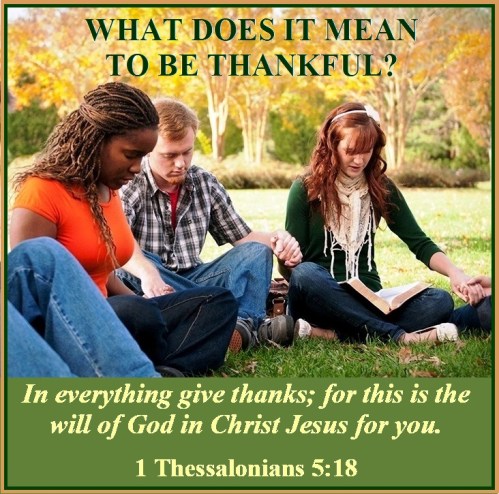
“In everything give thanks; for this is the will of God in Christ Jesus for you. Do not quench the Spirit.” (1 Thessalonians 5:18-19)
Webster’s dictionary states that the act of giving thanks; it is a grateful acknowledgment of benefits or favors and an expression of gratitude for something received, or done for, one.
So let us see what the Bible tells us about being thankful.
Paul declared, in Philippians 4:11, “I have learned in whatever state I am, to be content.” Being thankful is a learning process. It is allowing the Holy Spirit to place within us contentment demonstrating a real praise of thanksgiving to God for everything in one’s life. Biblical thankfulness is not what one does, but rather it is what one is; what one has become as a result of absolute and complete trust in our Lord and Savior Jesus Christ.
The Biblical meaning of the word of being thankful is the thankfulness that is instilled in us because the Holy Spirit lives within us. Therefore, once we are spiritually born again, a life of thanksgiving becomes a daily expression of Jesus’ life in us, as 1 Thessalonians 5:18-19 tells us: “in everything give thanks; for this is the will of God in Christ Jesus for you. Do not quench the Spirit.”
There are only two ways to face life: The natural way of complaining, murmuring and grumbling; the other attitude being to, “give thanks in everything” (1 Thessalonians 5:18) – “to count it all joy when you fall into various trials” (James 1:2) – “to rejoice always” (1 Thessalonians 5:16) – and remember, “that all things work together for good to those who love God, to those who are the called according to His purpose” (Romans 8:28).
It is the easiest thing in the world to complain. However, our “spiritual-attitude” is to constantly be one of praise to the Lord, since praise means “to exalt, to honor, to express approval – it is giving a positive affirmation.”
God’s eternal purpose for our life is to bring us into divine fellowship and communion with Him. The highest form of communion with God is that of giving thanks! We are to have an inner spiritual-attitude of thanksgiving, not because we feel good, but as an act of obedience to His Word and spiritual development of our Christian life.
God has promised to achieve this within our life however, in addition to God’s power within us; it also requires a setting of our will. God will not force anything upon us, but, if we cooperate with the life of the Holy Spirit living within us, and are thankful, God will release His power into whatever situation we go through.
Jesus said, “I have come that your joy might be full” (John 15:11). Jesus often said to His followers, “Be of good cheer!” In the same manner that God has commanded us to be honest, to be truthful and to be kind; it has commanded us to be cheerful. Being cheerful is a Christian duty, even when we don’t feel like it!
Jesus had a very difficult, hard life. He was a “man of sorrows” however His life was always radiant. He had an inner joy and no one was ever depressed by His presence.
The Bible commands us to “rejoice!” This does not take out the pain and the sorrow of our life as Jesus said, “In the world you will have tribulation; but be of good cheer, I have overcome the world” (John 16:33). In other words things are in My hands, I am victorious, in Me you have peace.”
Being thankful is not a question of whether we are going to give thanks or not, but it is a question of what spirit we will allow to rule us. Remember that when we have the characteristics of the Holy Spirit within us, He expresses Himself through praise.
So, why should we be thankful? Here are some reasons why we should be thankful:
- Because it honors God. When we are thankful, we recognize that God exists. Therefore, true thankfulness recognizes our total dependence on God and stems from realizing that everything going on in our lives and all we have is the product of God’s sovereign control, infinite wisdom, purposes and grace (2 Corinthians 4:15).
- Because it is commanded in Scripture. The Psalms are filled with the call to give thanks. “Enter into His gates with thanksgiving, and into His courts with praise. Be thankful to Him, and bless His name” (Psalm 100:4). Then Paul tells us to: “Let the peace of God rule in your hearts, to which also you were called in one body; and be thankful. . . And whatever you do in word or deed, do all in the name of the Lord Jesus, giving thanks to God the Father through Him” (Colossians 3:15, 17).
The next question is how should we give thanks?
First, we should give thanks whenever we pray. Scripture teaches us, both by example (Ephesians 1:16; Philippians 1:3-4; Colossians 1:3; 1 Thessalonians 1:2) and with confidence (Philippians 4:6; Colossians 4:2). That prayer should be offered in a context of thanksgiving, since being thankful turns our eyes from our problems and ourselves to the Lord that we might focus on Him and His sovereign grace. It helps us to see life through the perspective of God’s person, principles, promises, plan, provisions, and purposes. Then, as this happens, this upward focus promotes faith and courage in the face of the trying and painful situations that we all eventually face to one degree or another.
Second, we should always give thanks in everything and for everything (Ephesians 5:20; 1 Thessalonians 5:18). Why? In addition to the reasons already given, it helps us to focus on the sovereignty of God and the fact that He is in control and working all things together for good regardless of how they may seem to us in our limited perspective (Romans 8:28; James 1:2-4). While all things may not look good in our understanding, God uses them for good as we see in the story of Joseph. “Do not be afraid, for am I in the place of God? You intended to harm me, but God intended it for good to accomplish what is now being done, the saving of many lives” (Genesis 50:19-20).
Since a spirit of thankfulness keeps our eyes on the Lord, it also keeps us alert and promotes an eagerness to go to God in prayer to lay our burdens and those of others at His feet. Finally, we should always give thanks because it protects us against the dangers and consequences of thanklessness which dishonors God and leads to dependence on man rather than God (Romans 1:21).
Living in the Word keeps our focus where it belongs since God has designed the Christian life to be lived under the control and influence of the Holy Spirit. As a result, the Spirit-filled life is a vital source of thankfulness leading to “be filled with the Spirit, speaking to one another with psalms, hymns, and songs from the Spirit. Sing and make music from your heart to the Lord, always giving thanks to God the Father for everything, in the name of our Lord Jesus Christ” (Ephesians 5:18-20).
*******



Leave a comment