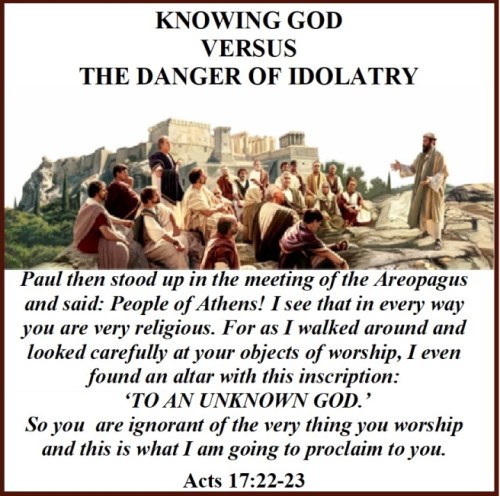
Paul then stood up in the meeting of the Areopagus and said: “People of Athens! I see that in every way you are very religious. For as I walked around and looked carefully at your objects of worship, I even found an altar with this inscription: TO AN UNKNOWN GOD. So you are ignorant of the very thing you worship—and this is what I am going to proclaim to you. (Acts 17:22-23)
In Acts 17:15, Paul arrives in Athens after traveling approximately 250 miles from Berea. Athens is a city in Greece that was famous for having many gods. In that city was the Areopagus (Acts 17:19, 22), or Mars Hill, where a council of civic leaders met. This council, also called the Areopagus, had charge of religious and educational matters.
It is here that Paul gave a most important gospel lecture during his second missionary journey (Acts 17:16–34). It was where he addressed the religious idolatry of the Greeks who even had an altar “TO AN UNKNOWN GOD.” It was this altar and their religious idolatry that Paul used as a starting point in proclaiming to them about the one true God and how they could be reconciled to Him.
We read that when Paul arrived in Athens he found a city “full of idols” (Acts 17:16). In his usual manner, Paul began presenting the gospel to both Jews and Gentiles. He started by “reasoning in the synagogue with the Jews and with the Gentile worshipers” (Acts 17:17) and then also proclaimed the gospel “in the marketplace daily with those who happened to be there” (Acts 17:17). While at the marketplace he encountered some Epicurean and Stoic philosophers (Acts 17:18) who, having heard Paul proclaim the resurrected Jesus Christ, wanted to learn about “this new doctrine” he was teaching. So they “brought him to the Areopagus” to hear more from him (Acts 17:19–20) about this new and strange teaching he was proclaiming.
Paul begins his message where the listeners are; and then presents the gospel in a logical and biblical fashion. Standing in the midst of the Areopagus, Paul’s presentation of the gospel is a great example for us, both as a pattern for how Paul identified with his audience and as an example of apologetics in action. His connection with his audience is seen in how he begins addressing those gathered at the Areopagus. He begins with the observation that they were “very religious,” based on the fact that they had many altars and “objects of worship” (Acts 17:23) including an altar “to an unknown god.” Paul uses that altar to introduce them to the one true God and the only way of salvation, Jesus Christ.
In their ignorance, the Greeks had erected altars to many gods and included an altar to a god they might have unintentionally left out. Paul uses this altar as an opportunity to explain that this “unknown god” was the biblical God, the Creator of heaven and earth, who does not dwell in temples made with hands (Acts 17:24-26). Actually, God is the Source of life for all nations, and He is really the One they were unconsciously seeking. Paul says God is near; in fact, “in Him we live and move and have our being” (Acts 17:27–28).
His apologetic method and his awareness that they did not even know what God is really like leads him to go back to Genesis and to the beginning of creation. Having a completely wrong view of God, those gathered that day needed to hear what God really was like before they would understand the message of the gospel. Paul begins explaining to them the sovereign God who created all things and gives life and breath to all things, similar to what Daniel told King Belshazzar, “You praised the gods of silver and gold, of bronze, iron, wood and stone, which cannot see or hear or understand. But you did not honor the God who holds in His hand your life and all your ways” (Daniel 5:23).
Paul continues to explain that it was God who created from one individual all men and nations and even appointed the time and boundaries of their dwelling (Acts 17:26). His message continues as he explains the closeness of God and their need to repent of their rebellion against Him.
Sadly there are many today that practice this form of idolatry, in violation of God’s command. The best way to reach these people with the gospel of grace is to pray that the Holy Spirit will draw them and that they will respond to the Spirit’s leading. Their eyes and hearts are blinded by the false teaching they are continually hearing, and, until they begin to seek the truth, we must leave it in God’s capable hands. As we pray, we must keep teaching them and trusting that God will prepare the soil of their hearts (Luke 8:11-15), as we never give up hope; since the Holy Spirit does miracles every day.
Paul completes his message by introducing them to the One before whom they would all stand one day and be judged – Jesus Christ, whom God had raised from the dead (Acts 17:31).
Of course, many in the audience scoffed at the idea that Christ was crucified and rose from the dead on the third day because the idea of the resurrection to the Greeks was foolishness (1 Corinthians 1:23). Yet a few believed what Paul said and joined him.
What happened at the Areopagus is important because of the many lessons that can be learned, not only from how Paul presented the gospel from a biblical worldview, but also in the varied responses he received. Some of those present that day believed and were saved, others mocked Paul and rejected his message, and still others were open-minded and desired to hear more. We can only hope that those who were open-minded were later convinced of the truth and also repented and believed.
As with all men, those who were confronted with the truth of the gospel and did not respond in faith had no guarantee of a second chance. As Hebrews 3:15 says, “Today if you will hear His voice, do not harden your hearts as in rebellion.” Paul’s message to the philosophers at the Areopagus that day ended with a call to repentance and acceptance of the two fundamental truths of Scripture that Paul was committed to preach – the crucifixion and resurrection of the Lord Jesus Christ. Paul preached Christ crucified to them as he always did wherever he went (1 Corinthians 2:2).
This “unknown God” desires to be known. That is why He speaks to us through His Word; that is why He sent His Son into the world (Luke 10:22), so that He can be known through faith in Jesus Christ.
The Greeks were unable to find the true God on their own, so God in His great mercy came searching for them.
Just as Paul did, we should also do the same that Jesus ordered all His disciples to do: “Therefore go and make disciples of all nations, baptizing them in the name of the Father and of the Son and of the Holy Spirit, and teaching them to obey everything I have commanded you. And surely I am with you always, to the very end of the age” (Matthew 28:19-20) – Amen.
*******



Leave a comment