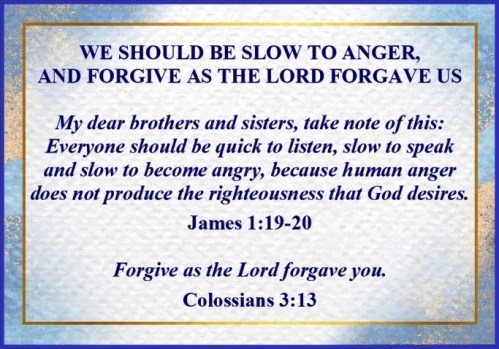
My dear brothers and sisters, take note of this: Everyone should be quick to listen, slow to speak and slow to become angry, because human anger does not produce the righteousness that God desires. (James 1:19-20)
Anger is a powerful emotion that often causes great damage. It fuels inner resentment and bitterness, shuts down communication, and breaks relationships. If unchecked, it boils over into explosive rage that hurts not only the intended target but others as well.
The decision to forgive is not only the best decision for our anger and for our relationships; it is the best decision for our relationship with the Lord. We need to remember that Scripture tells us that God does not forgive the unforgiving as Jesus said, “For if you forgive men when they sin against you, your heavenly Father will also forgive you. But if you do not forgive men their sins, your Father will not forgive your sins” (Matthew 6:14-15).
As we become aware of our repeated and grievous offenses committed against God, we want His gracious forgiveness, so we are directed to be gracious to our offenders in the same way. Therefore, it is not only good to forgive; it is necessary. In this regard, we are able to re-evaluate offense committed against us to see it in a new way – “Forgive as the Lord forgave you” (Colossians 3:13).
In Matthew 18:21-22, Peter asks Jesus, “Lord, how many times shall I forgive my brother or sister who sins against me? Up to seven times?” And Jesus’ answer astonishes Peter: “I tell you, not seven times, but seventy-seven times.” What the Lord is saying is that forgiveness has no limits. In the Christian life, our goal is to become more like Christ in every way, and our attitude toward releasing others from their wrongs is no exception.
When people experience the pain and anger associated with being hurt by someone, the question that often comes to mind is “why should I forgive?” Even when we are angry, we must be on guard that our anger does not become unrighteous and sinful! Finally, as we submit our anger to the Holy Spirit’s control we must work and make every effort to forgiving the offender (Colossians 3:12-14; Matthew 6:12, 14-15).
The idea of letting go of the anger and hurt and moving forward often seems both impossible and illogical. However, there are several good reasons to release those feelings of resentment and anger, and to resist the temptation of allowing them to develop into unforgiveness.
First: As Christians, we are called to forgive. In Ephesians 4:26-27, Paul urges the Christians at Ephesus to release their anger and forgive. He writes, “In your anger do not sin: Do not let the sun go down while you are still angry, and do not give the devil a foothold.” Paul is encouraging the Ephesians to let go of their anger each day and not to give Satan an opportunity to turn it into unforgiveness.
Second: Forgiveness is a gift to us since unforgiveness has been depicted as sitting in prison and forgiveness as being released from prison and trusting in the Lord for the ultimate carrying out of justice (Romans 12:19). Forgiveness allows us to move forward with our life, while unforgiveness causes us to re-live the painful situation over and over again.
Third: Forgiveness can benefit our mind and body. Studies have shown that forgiveness reduces rates of anxiety and depression, contributes to better sleep, and lowers blood pressure. Unforgiveness puts a strain on your heart, mind, and body, and over time, can negatively impact our health.
In spite of the fact that we often try to justify our anger, seldom can it be classified as righteous. Our motives are usually born of self-defense, thwarted desires, or outrage over alleged wrongs against us. Nevertheless, James wrote that our anger does not bring about God’s righteousness in our life.
The book of Proverbs gives God’s perspective on the subject. A quick-tempered person does foolish things (Proverbs 14:17), and “an angry person stirs up conflict, and a hot-tempered person commits many sins” (Proverbs 29:22). There are also warnings not to associate with such individuals so we don’t learn their ways (Proverbs 22:24-25). In contrast, those who are slow to anger have great understanding (Proverbs 14:29) and demonstrate wisdom by holding their temper (Proverbs 29:11).
Jesus paid our sin debt with His life in order to set us free from sin and that includes unrighteous anger. If God has convicted you of unrighteous anger, confess it as sin and ask Him to reproduce Christ’s character in you.
Jesus said: “‘Love the Lord your God with all your heart and with all your soul and with all your mind.’ This is the first and greatest commandment. And the second is like it: ‘Love your neighbor as yourself.’” (Matthew 22:37-39).
Therefore, we need to remember that forgiveness is one of the most powerful ways we demonstrate love just as God did for us by sending His beloved Son: “For God so loved the world, that He gave His only Son, that whoever believes in Him should not perish but have eternal life” (John 3:16).
*******



>
By: Hallelujah Living on September 28, 2022
at 5:39 pm