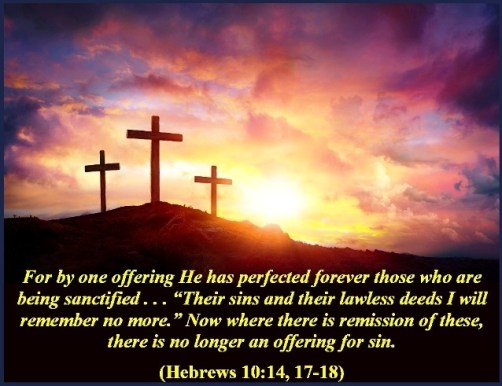
“For by one offering He has perfected forever those who are being sanctified. But the Holy Spirit also witnesses to us; for after He had said before, “This is the covenant that I will make with them after those days, says the Lord: I will put My laws into their hearts, and in their minds I will write them,” then He adds, “Their sins and their lawless deeds I will remember no more.” Now where there is remission of these, there is no longer an offering for sin.” (Hebrews 10:14-18)
Hebrews 10 and 7:27 explains how Jesus’ sacrifice on the cross for sin was a once and for all sacrifice. “Unlike the other high priests, he does not need to offer sacrifices day after day, first for his own sins, and then for the sins of the people. He sacrificed for their sins once for all when he offered himself.” As Scripture tells us, Jesus offered up Himself one time as a sacrifice and in so doing paid for all the sins of those that receive Him as their Lord and Savior.
Unlike the sacrificial system of the Old Testament, in which sacrifices were continually made for sin, Jesus paid for sin once for all. His payment was complete and the cross is empty.
There are several passages in the Bible that indicate that God forgives and forgets our sin. Isaiah 43:25 tells us: “I, even I, am He who blots out your transgressions for My own sake; and I will not remember your sins.”
And in Isaiah 1:18 the Lord tells us: “Come now, let us settle the matter,” …though your sins are like scarlet, they shall be as white as snow; though they are red as crimson, they shall be like wool.”
We need to understand that God is omniscient, He knows everything, and He forgets nothing. However, He chooses not to remember our sins. In human relationships, we can choose to remember the offenses someone has committed against us, or we can choose to forget. To forgive and forget, we must often put painful memories out of our mind. We don’t actually forget the sin, and it’s not that we are unable to recall the offense, but we choose to ignore it. Forgiveness is a choice that we make, that stops us from dwelling on past hurtful events.
Because of God’s great mercies He chooses to remove our sins from us “as far as the east is from the west, so far has He removed our transgressions from us” (Psalm 103:12); and Romans 8:1 tells us there is no condemnation for those who are in Christ.
Second Corinthians 5:21 says, “God made Him who had no sin [Jesus] to be sin for us, so that in Him we might become the righteousness of God.”
Knowing the complete forgiveness of God in Christ, we can join King Hezekiah in praising our Redeemer: “You have lovingly delivered my soul from the pit of corruption, for You have cast all my sins behind Your back” (Isaiah 38:17).
Even though theses verses tell us that God forgives and forgets, we need to repent and confess our sin as soon as we commit them. Otherwise, guilt will weigh heavily on us. We need to follow David’s example: “Then I acknowledged my sin to you and did not cover up my iniquity. I said, “I will confess my transgressions to the Lord.” And you forgave the guilt of my sin” (Psalm 32:5).
Again, it is important to note that, at the moment of true salvation, all of our sins are forgiven. On the cross, Jesus paid the penalty for our sins; once and for all time (Ephesians 1:7; Romans 5:6–11; Hebrews 10:1-18). After we are sealed with the blood of Christ’s covenant, there is nothing we can do that will keep us from heaven (Matthew 26:28). All of our sins – past, present, and future – are forgiven through the blood of Jesus Christ.
Yet, Jesus taught that believers must continue to seek God’s forgiveness daily, “forgive us our trespasses, as we forgive them that trespass against us” (Matthew 6:12). The reason for this is that after salvation, Christians still make mistakes as James tells us: “If anyone, then, knows the good they ought to do and doesn’t do it, it is sin for them” (4:17). For this reason, John wrote that when we fail, “If we confess our sins, He is faithful and just and will forgive us our sins and purify us from all unrighteousness” (1 John 1:9).
When our sins are confessed to God it enables us to walk in the pure light of genuine fellowship with Jesus Christ so that times of refreshing may come from the presence of the Lord (Acts 3:19).
*******



Leave a comment