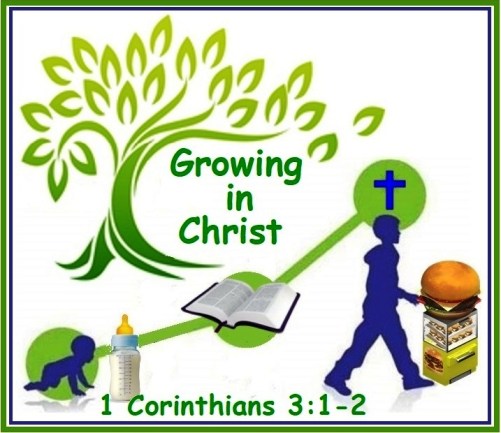
“Brothers and sisters, I could not address you as people who live by the Spirit but as people who are still worldly—mere infants in Christ. I gave you milk, not solid food, for you were not yet ready for it. Indeed, you are still not ready.” (1 Corinthians 3:1-2)
When we trust Christ as our personal Savior, we undergo regeneration or new birth because, “He saved us through the washing of rebirth and renewal by the Holy Spirit, whom He poured out on us generously through Jesus Christ our Savior” (Titus 3:5-6). At this moment, we are babes in Christ. There is joy when one is saved and born into the family of God, but there is sadness when a person remains a babe and doesn’t grow spiritually.
Paul writes that when he was with them, when they were first saved, he fed them with milk. By this, he means that he taught them the most basic things about God and what it means to be a Christian. As with any newborn, they were only prepared to consume and digest something very basic. Like babies, they began with milk. By now, they should be ready for solid food. Milk is meant to inspire growth to mature and empower a believer until they are ready to receive solid food.
These believers should now, be ready for more challenging truths of unselfishly walking in Christ and living according to the Spirit. However, they’re still not ready to chew. Why is it that the Corinthian Christians gained so little maturity?
The Corinthian church was failing to grow in Christ, and this grieved Paul, since he longed for that joy of watching babes in Christ grow. He writes similar words to the church in Ephesus, “until we all reach unity in the faith and in the knowledge of the Son of God and become mature, attaining to the whole measure of the fullness of Christ. Then we will no longer be infants, tossed back and forth by the waves, and blown here and there by every wind of teaching and by the cunning and craftiness of people in their deceitful scheming. Instead, speaking the truth in love, we will grow to become in every respect the mature body of him who is the head, that is, Christ” (Ephesians 4:13-15). Therefore, Paul holds all of them responsible for their own lack of growth.
Human babies and “babes in Christ” have similar characteristics. Babies are dependent and unable to feed themselves. They often get into trouble and make a mess. They need to be watched closely and demand a lot of time and attention. They have no control and no concern for others. They fuss, cry, and want their way. These are natural things that are typical and expected of babies, but when believers like the Corinthians, who were no longer new to the faith, exhibited characteristics like this, something was wrong, and it was time for them to grow up.
Paul pointed out to the Corinthians, “I gave you milk, not solid food.” The Word of God is our spiritual food. We receive spiritual nourishment through taking in God’s Word by reading, studying, and hearing it taught. Just as much as we need physical nourishment to live and grow, we need spiritual nourishment through the regular intake of God’s Word to live and grow.
Like newborns, babes in Christ begin with milk. The milk of the Word needs to be taught by someone credible (Hebrews 5:12). Then as newborns grow, they need more and more solid food. So it should be with babes in Christ that, as they grow, they should begin taking in the concrete food of the Word and be able to receive “the deep things of God” (1 Corinthians 2:10).
God calls each believer to grow and mature in Christ by His Word since “All Scripture is God-breathed and is useful for teaching, rebuking, correcting and training in righteousness, so that the servant of God may be thoroughly equipped for every good work” (2 Timothy 3:16-17).
And when it comes to our spiritual growth, we should never think that we’ve arrived because if we are hungry we will continue learning until Jesus calls us to be with Him.
We believe that we will continue to be fed in eternity since in the eternal state, man will be sinless and have eternal life, but the creation and the human being will always and forever remain dependent upon the Creator as the source of life. The ongoing need to access the tree of life for eternity reflects the continued dependence of the creatures upon the Creator, a reality which God apparently has chosen to manifest via the tree thru its fruits and leaves. “Then the angel showed me the river of the water of life, as clear as crystal, flowing from the throne of God and of the Lamb down the middle of the great street of the city. On each side of the river stood the tree of life, bearing twelve crops of fruit, yielding its fruit every month. And the leaves of the tree are for the healing of the nations” (Revelation 22:1-2).
So then, just as you received Christ Jesus as Lord, continue to live your lives in Him, rooted and built up in Him, strengthened in the faith as you were taught, and overflowing with thankfulness (Colossians 2:6-7).
*******



Leave a comment