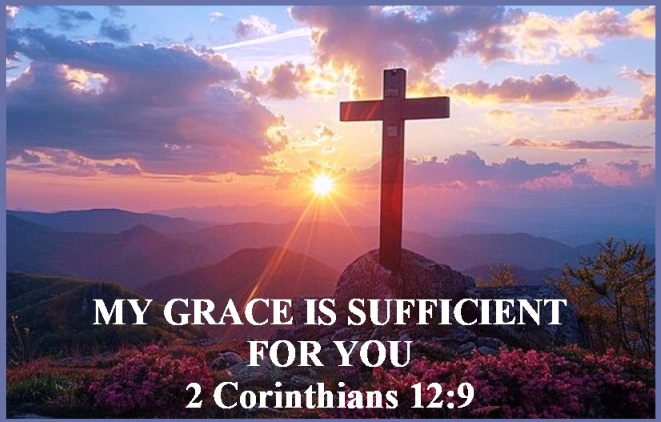
But He said to me, “My grace is sufficient for you, for My power is made perfect in weakness.” Therefore I will boast all the more gladly about my weaknesses, so that Christ’s power may rest on me. (2 Corinthians 12:9)
Paul has been describing a “thorn in the flesh,” (v. 7) some ongoing affliction that he repeatedly asked the Lord to remove. Instead of removing it, Christ answers with this promise, teaching Paul to rely on grace rather than on his own strength or comfort.
Here we see the God’s answer to Paul’s prayer in verse 8.
But He said to me, God answered the apostle’s prayer in a way that he did not expect. God denied his request. The Lord made this a standing or permanent answer to Paul. The thorn in the flesh made him dependent upon God’s grace. Once he came to know God’s will, he saw God’s higher purpose in his sufferings. God answered his prayer, although He denied his request.
My grace is sufficient for you, “grace” here was Christ working through the apostle to meet his needs. The word “sufficient” shows that God was adequate to meet Paul’s needs. He did not need to concern himself with his thorn. God’s grace was enough for the apostle. Therefore, if the apostle would depend on God’s grace, then God would get the glory.
For My strength is made perfect in weakness. God demonstrated His power through Paul’s weakness. “Made perfect” carries the idea of brought to completion. In the present tense, it meant that God was not finished with making Paul stronger in weakness. His weakness became the vehicle through which God worked. And God will do the same for you and me.
Therefore I will boast all the more gladly about my weaknesses. Paul concludes that he will “boast” in his weaknesses so that “the power of Christ may rest upon” him; treating trials as places where Christ’s power can be experienced more deeply.
This teaches us that we can live by learning to meet weakness, limitation, and pain with dependence on Christ instead of self-reliance. It calls for a conscious choice to trust that God’s grace is enough in the situation we are actually in, not just the one we wish we were in. Paul’s “thorn in the flesh” shows that God sometimes leaves difficult things in place so that reliance shifts from self to Christ.
Live one day’s grace at a time and when fear starts to rise, answer it with the context of this verse: God will supply the grace needed when I actually reach that moment. Learn to receive grace for today instead of trying to carry tomorrow’s burdens; God promises sufficient grace in the present, not what will happen in the future.
To summarize, we need grace to face difficult problems. Exercising the principle of grace in our lives can transform our Christian living and display God’s power in us.
The illusion that we have enough strength in ourselves to live the Christian life overlooks what the power of Christ can do in us. This is the reason God often brings us down from self-sufficiency. The surrender of our pride is a difficult issue but it will be lightened when we surrender to God’s power since God’s grace is the vehicle through which His power is fully active in us. It is not our weakness that is the power, but it brings us to the desire for God’s grace exercised in our lives.
We need to understand that at times, our pain is for our greater good, for it shows God’s greater glory. God’s will, not our desire, is the governing factor in whether He answers prayer.
God’s answer to Paul’s prayer was that His grace was sufficient for the apostle. He could bear his thorn through God’s provisions. Chastening is spiritual refinement and is the testing for character development. Just like Paul’s trust needed testing, so does ours every day.
Therefore, let us all join Paul in saying that we will gladly boast in our weaknesses so that Christ’s power may rest on us; knowing that “God’s grace is sufficient for each one of us” as He sustains the believer, even when prayers for relief are not answered the way we hope.
“That is why, for Christ’s sake, I delight in weaknesses, in insults, in hardships, in persecutions, in difficulties. For when I am weak, then I am strong” (2 Corinthians 12:10)
*******



Leave a comment