Was the prophecy of Jonah fulfilled?
Jonah 1:17 and Matthew 12:38-40
By: Mission Venture Ministries
Prophecy versus Tradition

As Jesus tells us in (Matthew 12:38-40) “Then some of the scribes and Pharisees said to Him, “Teacher, we want to see a sign from You.” 39 But He answered and said to them, “An evil and adulterous generation craves for a sign; and yet no sign will be given to it but the sign of Jonah the prophet; 40 for just as JONAH WAS THREE DAYS AND THREE NIGHTS IN THE BELLY OF THE SEA MONSTER, so will the Son of Man be three days and three nights in the heart of the earth “
Was the prophecy of Jonah really fulfilled in the burial experience of Jesus? According to the conventionally accepted chronology of events, it was not.
The customary chronology places the crucifixion on Friday morning and the burial on late Friday afternoon and the resurrection on Sunday morning. Thus, according to the traditional view, the body of Jesus was in the tomb only one full day (Saturday) and two full nights (Friday and Saturday). However, Jesus said His body would be in the tomb three days and three nights.
Jesus said all Messianic prophecy had to be fulfilled in Him, and we should believe that He meant every fact of every Messianic prophecy. Otherwise, it could be disputed that He was not the Messiah.
Let us think about the events in the last week of Jesus’ life to see if we can find some indication that will solve this dilemma. Perhaps the best place to begin is with the Scriptures. In (Mark 15:42) it says that the crucifixion took place on “the day of preparation before the Sabbath.”
This verse has led most people to believe that the crucifixion took place on a Friday since the Jewish Sabbath is Saturday. And that theory has in turn led to the conclusion that the crucifixion had to take place in 33 AD because that is the only year in the general time period of Jesus’ death when the day of preparation (14 Nisan on the Jewish calendar) fell on a Friday. In the year 31 and 32 AD the 14th of Nisan fell on a Monday.
Let us look at the Jewish Calendar.
A careful study of Jewish calendar will show that it is presumed that the day of preparation in the year of Jesus’ death had to fall on a Friday. Such a statement is based upon Gentile lack of knowledge about Jewish feast days. (After much research I have found that the 14th of Nisan falls only on a Monday, Wednesday, Friday or Saturday, starting at sundown the day before and ending at sundown on a Monday, Wednesday, Friday or Saturday). Genesis 1:5, 8, 13, 19, 23, 31 states: “and there was evening and there was morning.” Therefore the Jews start their day in the evening.
Please check this out for yourselves at this web site:
http://www.fourmilab.ch/documents/calendar/
What the Gentile church has failed to recognize over the centuries is that the first day after Passover (15 Nisan) is a feast day, or “high day” because it is the beginning of the Feast of Unleavened Bread. It is therefore considered to be a Sabbath. Read Numbers 28:16-18. Verse 18 clearly indicates that the first day after Passover, Nisan 15, is to be observed as a Sabbath – and so it has been throughout Jewish history to this day.
Now, the Gospel of John makes it clear that the Sabbath after the crucifixion was not a regular Sabbath; rather, it was a feast day Sabbath, marking the beginning of the Feast of Unleavened Bread. Consider the words of John 19:31 – “The Jews, therefore, because it was the day of preparation, so that the bodies should not remain on the cross on the Sabbath (for that Sabbath was a high day), asked Pilate that their legs might be broken, and that they might be taken away.”
Again, the point of all this is that Jesus did not have to be killed on a Friday in order for His crucifixion to precede the Sabbath because there were two Sabbaths during the week of His crucifixion, depending on what day of the week the high feast day fell on. If the 14th of Nisan fell on Monday, Wednesday or Friday, there would be two Sabbaths in a week. If it fell on a Saturday, they there would only be one Sabbath in a week because the High Holy Day of the 15th of Nisan would fall at the beginning of the following week. Saturday is the least common day of the week for the 14th of Nisan to occur.
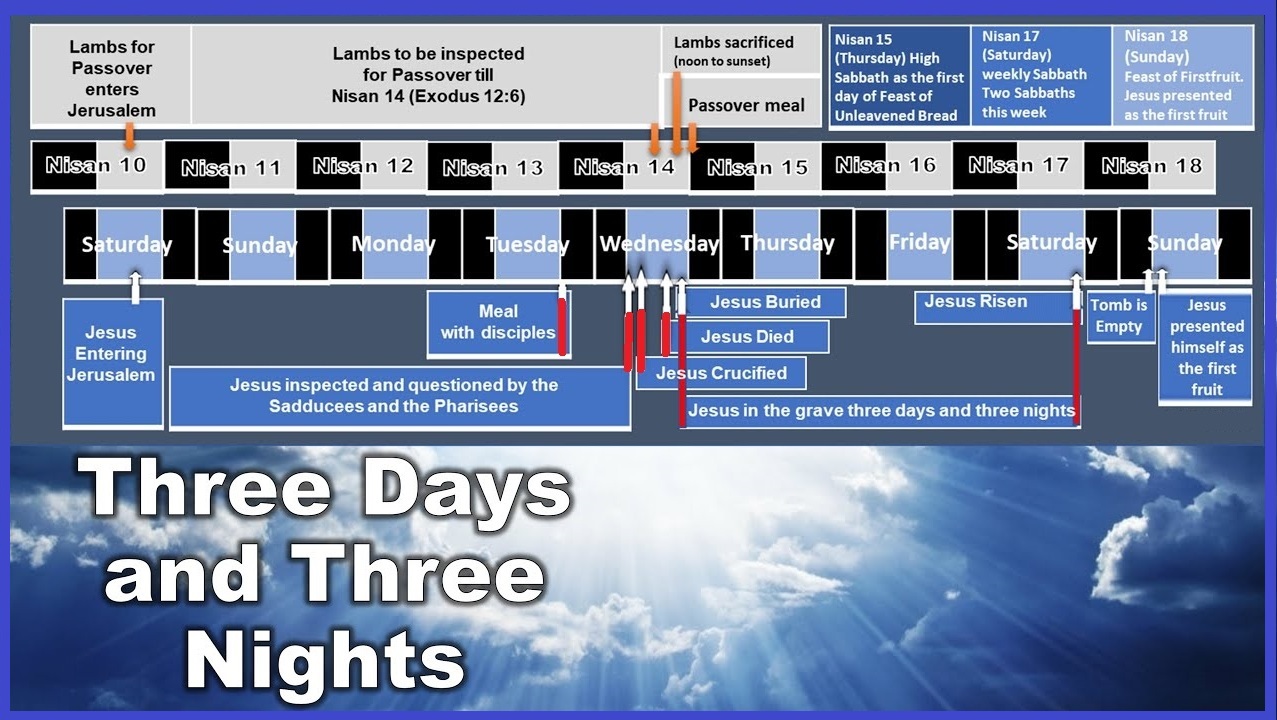
Take the year 30 AD for example. In that year the 14th of Nisan, the Passover day in which Jesus would have been crucified, fell on Wednesday, April 3rd. The next day Thursday, would have been the high feast day, and therefore it would have been a Sabbath.
Thus, if Jesus was crucified in the year 30, He would have been crucified on Wednesday and buried that evening before the high feast day Sabbath began. His body would have remained in the tomb for three days (Thursday, Friday and Saturday) and three nights (Wednesday, Thursday and Friday), just as He predicted. That means His resurrection would have taken place on Saturday evening, April 6th. To the Jew, that would place the Lord’s resurrection on Sunday, the first day of the week, because the Jewish day begins at sundown.
LET US TAKE A LOOK AT THE FOLLOWING CHART

NOTE: Here are some clues in the Scriptures that the crucifixion week had two Sabbaths.
In Mark 16:1 it says: “When the Sabbath was over, Mary Magdalene, Mary the mother of James, and Salome bought spices so that they might go to anoint Jesus’ body.”
In Luke 23:56 it says: “Then they went home and prepared spices and perfumes. But they rested on the Sabbath in obedience to the commandment.”
There seems to be only one explanation of the apparent contradiction in these verses. After resting on the high Sabbath – Thursday, the ladies bought the spices on Friday and after preparing them, they rested again on the regular weekly Sabbath, on Saturday, before proceeding to the tomb on Sunday morning. This explains how they could have bought the spices both before and after the Sabbath. They bought the spices after the high Sabbath on Thursday, and before the regular Saturday, which would have been on Friday.
Why did the women buy the Spices?
Let us take a look at the verses in the Gospels.
FIRST: in Matthew 27:57-61
Jesus Is Buried
When it was evening, there came a rich man from Arimathea, named Joseph, who himself had also become a disciple of Jesus. 58 This man went to Pilate and asked for the body of Jesus. Then Pilate ordered it to be given to him. 59 And Joseph took the body and wrapped it in a clean linen cloth, 60 and laid it in his own new tomb, which he had hewn out in the rock; and he rolled a large stone against the entrance of the tomb and went away. 61 And Mary Magdalene was there, and the other Mary, sitting opposite the grave.
Here we see were Mary Magdalene and the other Mary sitting opposite the grave however, Matthew does not refer to them buying any spices.
SECOND: in Mark 15:42-47
Jesus Is Buried
When evening had already come, because it was the preparation day, that is, the day before the Sabbath, 43 Joseph of Arimathea came, a prominent member of the Council, who himself was waiting for the kingdom of God; and he gathered up courage and went in before Pilate, and asked for the body of Jesus. 44 Pilate wondered if He was dead by this time, and summoning the centurion, he questioned him as to whether He was already dead. 45 And ascertaining this from the centurion, he granted the body to Joseph. 46 Joseph bought a linen cloth, took Him down, wrapped Him in the linen cloth and laid Him in a tomb which had been hewn out in the rock; and he rolled a stone against the entrance of the tomb. 47 Mary Magdalene and Mary the mother of Joses were looking on to see where He was laid.
Here again we see Mary Magdalene and the Mary the mother of Joses and there is nothing said about spices until after the Sabbath was over.
Mark 16:1-2 says: When the Sabbath was over, Mary Magdalene, and Mary the mother of James, and Salome, bought spices, so that they might come and anoint Him. 2 Very early on the first day of the week, they came to the tomb when the sun had risen.
THIRD: in Luke 23:50-56
Jesus Is Buried
And a man named Joseph, who was a member of the Council, a good and righteous man 51 (he had not consented to their plan and action), a man from Arimathea, a city of the Jews, who was waiting for the kingdom of God; 52 this man went to Pilate and asked for the body of Jesus. 53 And he took it down and wrapped it in a linen cloth, and laid Him in a tomb cut into the rock, where no one had ever lain. 54 It was the preparation day, and the Sabbath was about to begin. 55 Now the women who had come with Him out of Galilee followed, and saw the tomb and how His body was laid. 56 Then they returned and prepared spices and perfumes and on the Sabbath they rested according to the commandment.
Here we see the women who had come with Him from Galilee, they see the tomb and how His body was laid and then they returned and prepared spices and perfumes. There were restrictions according to Jewish customs of what they were allowed to do on a Sabbath, so they probably rested on the High Sabbath according to the commandment and most likely prepared the spices on Friday. (We do not know how long it took to prepare the spices, but it must have taken some time. In addition, they needed to prepare for the regular Sabbath.)
Luke 24:1 But on the first day of the week, at early dawn, they came to the tomb bringing the spices which they had prepared.
It is interesting to note that only Mark and Luke record the women buying and preparing the spices to anoint Jesus.
FOURTH: we take a look at John 19:31-42
Care of the Body of Jesus
Then the Jews, because it was the day of preparation, so that the bodies would not remain on the cross on the Sabbath (for that Sabbath was a high day), asked Pilate that their legs might be broken, and that they might be taken away. 32 So the soldiers came, and broke the legs of the first man and of the other who was crucified with Him; 33 but coming to Jesus, when they saw that He was already dead, they did not break His legs. 34 But one of the soldiers pierced His side with a spear, and immediately blood and water came out. 35 And he who has seen has testified, and his testimony is true; and he knows that he is telling the truth, so that you also may believe. 36 For these things came to pass to fulfill the Scripture, “NOT A BONE OF HIM SHALL BE BROKEN.” 37 And again another Scripture says, “THEY SHALL LOOK ON HIM WHOM THEY PIERCED.” 38 After these things Joseph of Arimathea, being a disciple of Jesus, but a secret one for fear of the Jews, asked Pilate that he might take away the body of Jesus; and Pilate granted permission. So he came and took away His body. 39 Nicodemus, who had first come to Him by night, also came, bringing a mixture of myrrh and aloes, about a hundred pounds weight. 40 So they took the body of Jesus and bound it in linen wrappings with the spices, as is the burial custom of the Jews. 41 Now in the place where He was crucified there was a garden, and in the garden a new tomb in which no one had yet been laid. 42 Therefore because of the Jewish day of preparation, since the tomb was nearby, they laid Jesus there.
Here we see Joseph of Arimathea and Nicodemus taking care of Jesus’ body according to the Jewish customs and there is no mention of any of the women being there.
In the day of Jesus, Jewish society was very structured. Every aspect of life was precisely defined and controlled by religious beliefs. This included burial rituals.
The Bible is even very clear on this matter. John 19:38-40 is very precise in indicating that Joseph of Arimathaea and Nicodemus prepared Jesus’ body in the manner of the Jews for proper burial. This procedure involves extensive wrapping of the body, while including a lot of myrrh and aloes that would get placed between the various layers of cloth. Specifically, John 19:40 says, that “Then took they the body of Jesus, and wound it in linen clothes with the spices, as the manner of the Jews is to bury.”
In preparing a body for burial according to Jewish custom, it was usually washed and straightened, and then bandaged tightly from the armpits to the ankles in strips of linen about a foot wide. Aromatic spices, often of a gummy consistency, were placed between the wrappings or folds. They served partially as a preservative and partially as a cement to glue the cloth wrappings into a solid covering.
In both the ancient and modern procedure, and in the description of the custom, the head was never wrapped in such a way and the face would remain uncovered. It is very likely that the neck and upper shoulders were also not wrapped in the linen strips.
The spices, the myrrh and the aloes, may have been placed dry or in the gummy consistency mentioned above. If they were placed dry between the various layers and folds of the linen, in the case of Jesus, it would not seem that we would still have the ‘glue’ effect mentioned above. However, in addition, a semi-liquid unguent such as nard was initially used to anoint the body. The effect of this would be to cause the powdered myrrh and aloes near the body to strongly adhere to the body and to the layers of linen. Outer layers of myrrh and the aloes might have remained as a dry powder.
The point being made here is that in either case, this complex and involved wrapping of many narrow strips of cloth would naturally have stuck together so strongly as to effectively make a relatively rigid ‘cocoon’ around the body.
The head and hair were anointed with the nard unguent, but the powdered spices do not appear to have been applied to the head or face. A small separate ‘face cloth’ or ‘napkin’ was generally placed on the face or around the head. John 20:7 refers to this separate cloth, so this aspect of the custom was definitely used regarding Jesus. Rather than ONE piece of cloth, certainly at least two separate pieces are described here.
Several points should be noted. A HUNDRED POUNDS (about 75 pounds in today’s equivalency) of myrrh and aloes were applied during the burial preparation. Jewish custom did not involve using a single cloth, but rather a number of long strips of linen that were tightly wrapped many times around the body. The presence of the myrrh and the nard would have made the burial clothes become extremely rigid. The burial clothes were never extended to cover the head or face but only wrapped the body.
So why Were the Women Going to Anoint Jesus?
Could it be that these women maybe did not have the opportunity to witness Joseph of Arimathea and Nicodemus prepare the body for burial as we read in the Gospel of John? Matthew, Mark and Luke only make reference to: Joseph bought a linen cloth, took Him down, wrapped Him in the linen cloth and laid Him in a tomb which had been hewn out in the rock.
Could it be that Joseph bought a linen cloth, took Him down, wrapped Him in the linen cloth and laid Him in a tomb which had been hewn out in the rock; – Mark 15:46 and that he then waited for Nicodemus to come with the spices to prepare Jesus’ body for proper burial? They might have laid Jesus’ body in the tomb just with the linen cloth to keep it safe until they could prepare His body for burial.
Since the women apparently did not witness these things, they wanted to anoint Him the first opportunity they had, so that is why they went and bought and prepared spices. The other thought is that they might have wanted to place additional spices around the body in the tomb so there would be a sweet fragrance around the body of their beloved Jesus. Their mind was on the lifeless Jesus and this would be the last opportunity they could do to honor Him with a final loving gesture. The thought of Jesus coming to life, had probably not crossed their mind, and if it did, it was something very difficult for them to understand; however, they would believe when they finally saw the resurrected Savior.
We note in John 12:1-3 that Mary, Lazarus sister, anointed Jesus six days before His death: “Six days before the Passover, Jesus arrived at Bethany, where Lazarus lived, whom Jesus had raised from the dead. 2 Here a dinner was given in Jesus’ honor. Martha served, while Lazarus was among those reclining at the table with him. 3 Then Mary took about a pint of pure nard, an expensive perfume; she poured it on Jesus’ feet and wiped his feet with her hair. And the house was filled with the fragrance of the perfume.”
And Jesus acknowledged this in John 12:7 “”Leave her alone,” Jesus replied.” It was intended that she should save this perfume for the day of my burial.”
Note: As already observed, nard was one of the spices used in the burial of the dead.
The Grave Clothes Tell a Tale.
The tomb was empty, however his burial clothes where there. Luke tells us in chapter 24:12 that Peter bending over, saw the strips of linen lying by themselves, and he went away, wondering to himself what had happened. In John we read in Chapter 20:4-8 The two were running together; and the other disciple ran ahead faster than Peter and came to the tomb first; 5 and stooping and looking in, he saw the linen wrappings lying there; but he did not go in. 6 And so Simon Peter also came, following him, and entered the tomb; and he saw the linen wrappings lying there, 7 and the face-cloth which had been on His head, not lying with the linen wrappings, but rolled up in a place by itself. 8 So the other disciple who had first come to the tomb then also entered and he saw and believed.
John, the beloved disciple of Jesus, looked over to the place where the body of Jesus had lain, and there were the grave clothes, in the form of the body, empty, like the empty chrysalis of a caterpillar’s cocoon. One could only imagine that what they saw was enough to make a believer out of anybody. I believe that the first thing that stuck in the minds of the disciples was not the empty tomb, but rather the empty grave clothes, undisturbed in form and position.
Another Validation by the Jewish Historian Josephus.
A fascinating fact that also indicates that the resurrection probably occurred in 30 AD is to be found in the writings of Josephus, the first century Jewish historian. He says the last Jubilee that was celebrated in the land (before the Roman conquest in 70 AD) began in 27 AD.
That date most likely marks the beginning of Jesus’ ministry, for His ministry was a symbolic fulfillment of the Jubilee promises. This is indicated by the scripture that Jesus read in the synagogue in Nazareth when He launched His public ministry (Luke 4:16-24 & Isaiah 61:1-2):
The Spirit of the Lord is upon Me, because He anointed Me to preach the Gospel to the poor. He has sent Me to proclaim release to the captives, and recovery of sight to the blind, to set free those who are downtrodden, to proclaim the favorable year of the Lord.
It is commonly agreed that the ministry of Jesus lasted 3 ½ years. A launching date of 27 AD to coincide with the Jubilee year would place His death in the spring of 30 AD – a year in which the Passover week had two Sabbaths.
Review of the Order of Events Regarding the Death, Burial and Resurrection of Jesus
1) Jesus and His disciples ate the Passover meal on Tuesday evening Exodus 12:6-10 (which was already Wednesday, the 14th of Nisan in the Jewish calendar) in the Upper Room on Mount Zion.
2) After the Passover meal, Jesus and His disciples departed the Upper Room and walked to the Garden of Gethsemane in the Kidron Valley between the Old City and the Mount of Olives.
3) Jesus was betrayed and arrested Tuesday evening. His various trials lasted throughout Tuesday night and early Wednesday morning.
4) Jesus was crucified at about 9:00 am on Wednesday morning. At noon, darkness filled the land. At about 3:00 pm Jesus died.
5) Jesus was buried on Wednesday about sunset.
6) The two Mary’s waited until after the high Sabbath on Thursday to purchase the spices for the anointing of Jesus’ body. They bought the spices on Friday, prepared them, and then rested again during the regular Sabbath before returning to the tomb on Sunday morning.
7) The resurrection of Jesus occurred near sunset, exactly three days and three nights after burial, fulfilling the sign of Jonah and authenticating the sign He gave of His Messiahship. The resurrection was discovered on Sunday morning when the women returned to the tomb.
One More Question to be Considered . . .
What did the two disciples on the road to Emmaus mean when they said, “Today is the third day since these things happened?”
Does the phrase “the third day” in Luke 24:21 contradict Christ’s promised sign that He would be three days and three nights in the grave? What events are being referred to as “since these things happened”?
It’s logical to question how it could be the third day, when Christ was in the grave for a full three days and three nights as He had promised in Matthew 12:39-40. In Luke 24, the two disciples referred to Sunday as being the third day since “all these things” (Luke 24:14) happened. There were other things the Jews and Romans did after Christ was buried. Notice what Matthew included about their actions:
“On the next day, which followed the Day of Preparation, the chief priests and Pharisees gathered together to Pilate, saying, ‘Sir, we remember, while He was still alive, how that deceiver said, “After three days I will rise.” Therefore command that the tomb be made secure until the third day, lest His disciples come by night and steal Him away, and say to the people, “He has risen from the dead.” So the last deception will be worse than the first.’ Pilate said to them, ‘You have a guard; go your way, make it as secure as you know how.’ So they went and made the tomb secure, sealing the stone and setting the guard” (Matthew 27:62-66).
Christ had already been buried nearly one whole day when these things were done. The last things the Romans and Jewish leaders did were to seal the tomb and place soldiers on guard around it. Christ died on Wednesday afternoon at about 3:00 pm. So the tomb was sealed on Thursday, the day following that Day of Preparation. Apparently the disciples were including these events in their reference to the things that had taken place. Counting from the securing of the tomb and the setting of the guard, Sunday would have been the “third day” since “all these things” happened.
Does it Make a Difference?
Prophecy and its fulfillment validate Jesus as who He said He was – namely, God in the flesh. Prophecy and its fulfillment also validate the Bible as the inspired Word of God. Prophecy must be fulfilled precisely, not approximately.
The precise fulfillment of prophecy regarding the First Coming of Jesus is our assurance that all the prophecies regarding His Second Coming will also be fulfilled completely to the last detail. God will not overlook or forget anything. He is true to His Word and He keeps His promises.
*******
*******


Dear brethren in the Lord warm christian greetings to you all in the precious name of our Lord Jesus Christ. Please continue in faith, knowing God’s grace is sufficient, and His blessings with find their way to you. We remain committed to keeping you in our prayers, asking the Lord to guide, protect, and provide for you more resources in your ministry. We are still waiting for Bibles in our local languages and His God is provide.
By: messengerchrist on April 7, 2026
at 10:52 pm
Continuing to trust in the Lord because He is the great provider. Blessings to you and yours.
By: missionventureministries on April 8, 2026
at 12:15 pm
This is our Bible study and visiting our fellow believers and door to door evangelism.I’m Mambwe obed from right to left on number 2 and wearing a chitenge shirt material. Thank you!
By: messengerchrist on April 7, 2026
at 10:58 pm
God bless!
By: missionventureministries on April 8, 2026
at 12:13 pm