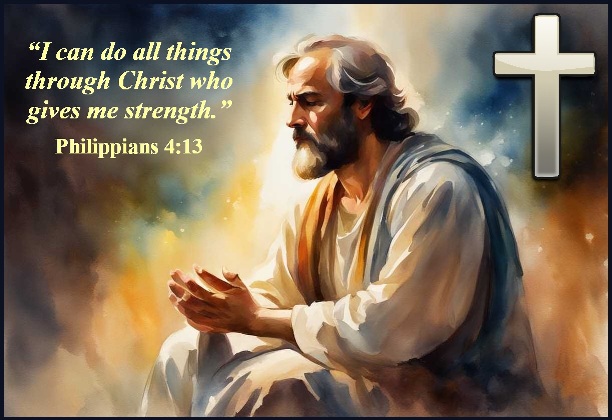
“I can do all things through Christ who gives me strength.” (Philippians 4:13)
Paul is describing how he has learned to be content in every circumstance—whether he has plenty or is hungry and in need. His strength to endure comes from Christ. The verse expresses confidence in Christ’s sustaining power, rather than a promise of unlimited success in any personal ambition.
Paul is explaining that Christ strengthens him to live faithfully whether he has plenty or is suffering need while imprisoned. The Christians in Philippi had sent him material support through Epaphroditus; therefore, in Philippians 4:10–20 Paul thanks them for their generosity. But he also makes clear that his contentment does not depend entirely on receiving their gift.
The rationalization develops across the passage:
Verses 10–11: Paul rejoices at their renewed support, but explains that he has learned to be content whatever his circumstances.
Verse 12: He names the circumstances he means: being well fed or hungry, having plenty or being in need.
Verse 13: “I can do all this through him who gives me strength.” Christ is the source of his ability to face those conditions.
Verse 14: He immediately adds that it was good of them to share in his troubles and wants them to know that depending on Christ does not make their practical help unnecessary or unimportant.
The phrase “all things” points back to the situations Paul has just described. His point is not, “I can achieve anything I set my mind to,” but, in other words: “Through Christ’s strength, I can face both abundance and hardship with contentment.”
This makes the verse an encouragement in difficulty without promising that difficulty will disappear. Paul’s confidence is not that he will always get the circumstances he wants, but that Christ can sustain him within the situation he faces.
This verse is NOT about believing in myself. The emphasis is not on Paul’s unlimited potential or willpower, but on his dependence on Christ. Turning the verse into a self-confidence slogan shifts its focus away from the source of strength Paul identifies which is Christ.
The verse is there to encourage someone facing a difficult task. The important distinction is between “Christ guarantees the outcome I want” and “Christ can sustain me even when the outcome is not what I want.” The second reflects the passage’s emphasis on contentment and faithful endurance trusting in the Lord.
Finally, Philippians 4:13 is part of a larger passage that addresses Christ’s ability to meet our needs. Christ can give contentment during times of plenty and of poverty. He can help us do all things through His strength. In Paul’s case, it was the strength to serve as a missionary despite facing intense suffering. In our lives, this same strength is available. Whether we serve in another country or help someone in our own community, Christ’s power can enable us to stand firm on His promises and endure the most difficult of life’s challenges. Paul concludes this passage with these words: “My God will meet all your needs according to the riches of his glory in Christ Jesus. To our God and Father be glory for ever and ever. Amen” (Philippians 4:19–20). Hallelujah, praise the Lord, what a beautiful promise to stand on!
*******



Leave a Reply