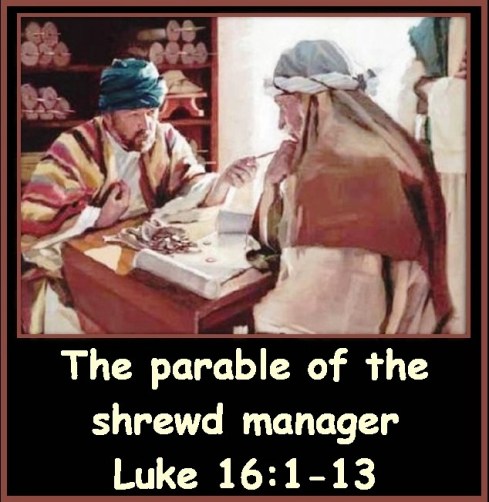
“I tell you, use worldly wealth to gain friends for yourselves, so that when it is gone, you will be welcomed into eternal dwellings.” (Luke 16:9)
The Parable of the shrewd manager can be found in Luke 16:1–13. The text can be broken down into two parts: the parable (verses 1–8) and the application (verses 9–13). Luke 16:1 identifies that Jesus is speaking to His disciples, but there is a suggestion that His audience is mixed—disciples and Pharisees since Luke 16:14 states that the “Pharisees, who loved money, heard all this and were sneering at Jesus.”
The parable is for the benefit of the disciples, but there is also a not-so-subtle critique of the Pharisees. Verse 16:14 is Luke’s commentary on the motivation of the Pharisees, and in verse 15 we see our Lord condemn their motives “He said to them, “You are the ones who justify yourselves in the eyes of others, but God knows your hearts. What people value highly is detestable in God’s sight.” And what was the Pharisees’ motivation? They were those who were “lovers of money” and who “justify themselves before men” and who exalted that which was an “abomination before God.”
Since we’re all prone to the world’s ways, we need to think carefully about what Jesus is saying so that we follow God’s way to true riches rather than the world’s way to deceptive wealth and ultimate, eternal poverty.
The story is simple, but the setting is unusual. In most of Jesus’ parables, the character is either representative of God, Christ, or some other positive personality. In this parable the characters are all wicked; the manager and the man whose possessions he manages are both unpleasant characters. This should alert us to the fact that Jesus is not exhorting us to emulate the behavior of the characters but is trying to expound on a larger principle.
The parable begins with a rich man calling his manager before him to inform him that he will be relieving him of his duties for mismanaging his master’s resources. A manager is a person who supervises the resources of another. The manager had authority over all of the master’s resources and could transact business in his name. This requires the utmost level of trust in the manager. Now, it may not be apparent at this point in the parable but is made more evident later on, that the master is probably not aware of the steward’s dishonesty. The manager is being released for apparent mismanagement, not fraud. This explains why he is able to conduct a few more transactions before he is released and why he is not immediately tossed out on the street.
The manager, realizing that he will soon be without a job, makes some shrewd deals behind his master’s back by reducing the debt owed by several of the master’s debtors in exchange for shelter when he is eventually put out on the street. When the master becomes aware of what the wicked manager had done, he commends him for his “shrewdness.”
In His application of the story in the remaining verses, Jesus begins by saying, “The master commended the dishonest manager because he had acted shrewdly. For the people of this world are more shrewd in dealing with their own kind than are the people of the light” (Luke 16:8). Jesus is defining a contrast between the “sons of the world” i.e., unbelievers and the “sons of light” believers. Unbelievers are wiser in the things of this world than believers are about the things of the world to come. The unjust manager, once he knew he was about to be put out, maneuvered to collect some quick cash, cheat his master, who more than likely was cheating his customers, and make friends of his master’s debtors, who would then be obligated to care for him once he lost his job.
What does this have to do with believers being wise about the life to come? Let’s look at verse 9: “I tell you, use worldly wealth to gain friends for yourselves, so that when it is gone, you will be welcomed into eternal dwellings.” Jesus is encouraging His followers to be generous with their wealth in this life so that in the life to come their new friends will receive them “into eternal dwellings.” This is similar to Jesus’ teaching on wealth in the Sermon on the Mount where Jesus exhorts His followers to lay up treasures in heaven (Matthew 6:19–21).
By the term worldly wealth Jesus is not saying that believers should gain wealth in an unrighteous way and then be generous with it. Unrighteous in reference to wealth can refer to:
- the means in acquiring wealth;
- the way in which one desires to use the wealth; or
- the corrupting influence wealth can have that often leads people to commit unrighteous acts.
Given the way in which Jesus employs the term, the third explanation seems the most likely. Wealth is not inherently evil, but the love of money can lead to all sorts of sin (1 Timothy 6:10).
So, the principle that Jesus is trying to convey is one of a just manager rather than an unjust one. The unjust manager saw his master’s resources as a means for his own personal enjoyment and advancement. Conversely, Jesus wants His followers to be just, righteous managers. If we understand the principle that everything we own is a gift from God, then we realize that God is the owner of everything and that we are His stewards. As such, we are to use the Master’s resources to further the Master’s goals. In this specific case, we are to be generous with our wealth and use it for the benefit of others.
Jesus then goes on to expand in verses 10–13 the principle given in verse 9. If one is faithful in “little” i.e., “unrighteous” wealth, then one will be faithful in much. Similarly, if one is dishonest in little, he will also be dishonest in much. If we can’t be faithful with earthly wealth, which isn’t even ours to begin with, then how can we be entrusted with “true riches”? The “true riches” here is referring to stewardship and responsibility in God’s kingdom along with all the accompanying heavenly rewards.
The climax of Jesus’ application is verse 13: “No one can serve two masters. Either you will hate the one and love the other, or you will be devoted to the one and despise the other. You cannot serve both God and money,” which Jesus also speaks of in Matthew 6:24.
If God is our Master, then our wealth will be at His disposal. In other words, the faithful and just manager who’s Master is God will employ that wealth in building up the kingdom of God.
Jesus is telling us that there is a way we can take it with us, namely, by wisely investing the resources that God has entrusted us now in things that matter for eternity.
Each of us must ask ourselves the sober question, “Am I managing the resources God has entrusted to me with a view to giving an account some day in light of His purpose of being glorified among all the nations through the spreading of the gospel?” God is a generous and gracious Father, who gives to us not only enough for our basic needs, but also for our enjoyment. So, it is not wrong to enjoy many things beyond the bare essentials. But, if we grasp the concept of faithful stewardship and accountability, our focus will not be on our own financial success, but rather on the financial “success” of God’s enterprise, namely, the gospel.
The application for us is we know that the time is soon coming when the possessions of unrighteousness will fail. We will die or Christ will return, and money won’t do us any good in heaven; that we should use our money now to store up treasures in heaven by making eternal friends through the gospel. Can you imagine the joy someday of meeting someone in heaven who says, “Thank you for giving to the cause of world evangelization, because you gave, missionaries came to my country and I got saved.”
Please understand that it’s not that you can give enough to get into heaven. Heaven is God’s gift, freely available through the death of Christ who paid the penalty for the sins of all who will receive Him. If you think that any amount of good works will get you into heaven, you do not understand the gospel. You can get into heaven only by acknowledging that you are a sinner and trusting in Christ as your Savior from sin and judgment.
But if you have received God’s gift of eternal life, you must live with God as your Master, not possessions. We need to ask ourselves, “Am I living as a faithful manager, shrewdly using the resources God has entrusted to me to lay up treasures in heaven? Or, have I slipped into squandering God’s resources for my own purposes, losing sight of the fact that eternity is quickly approaching?” Therefore, invest your Master’s money in that which will pay eternal dividends.
********



Leave a comment