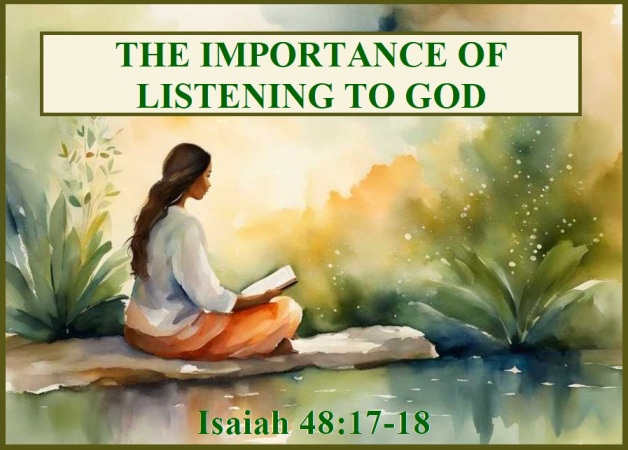
This is what the Lord says, your Redeemer, the Holy One of Israel: “I am the Lord your God, who teaches you what is best for you, who directs you in the way you should go. If only you had paid attention to my commands, your peace would have been like a river, your well-being like the waves of the sea. (Isaiah 48:17-18)
These verses apply to daily Christian living by inviting believers to trust God as the wise Teacher of what is truly good, to follow His revealed direction in Scripture, and to recognize that walking in obedience is closely tied to experiencing deep peace.
First: These verses present God as “the Lord your God, who teaches you what is best for you.” In daily life this means:
- Turning first to Scripture, prayer, and the Spirit’s guidance when making decisions, rather than relying only on impulses, trends, or peer pressure.
- Expecting that God’s commands are not arbitrary restrictions but instructions from a Redeemer who knows what leads to genuine success in reaching the peace of God which transcends all understanding, will guard your hearts and your minds in Christ Jesus (Philippians 4:7).
In practical terms, that can look like pausing before a big choice (job, relationship, finances) and asking, “What does God’s Word teach about this? What would honor Him and reflect His character?”
Second: God says He “directs you in the way you should go.” For everyday Christian living this suggests:
- Seeking God’s will through regular Bible reading, prayer, godly counsel, and believing that He wants to guide you.
- Being willing to obey even when His way is counter-cultural (e.g., honesty over benefit, generosity over greed, purity over dishonor).
Many Christians report that they already sense what God is saying through Scripture and conscience but choose their own path; these verses highlight the cost of that choice.
Third: Verse 18 links attention to God’s commands with “peace… like a river” and “righteousness / well-being like the waves of the sea.” The application is both a warning and a promise:
- WARNING: Much anxiety, conflict, and emptiness come from knowingly ignoring what God has already taught.
- PROMISE: As you align your life with God’s commands, you can expect a deep, stabilizing peace that keeps flowing even when circumstances are tough.
This doesn’t mean a problem-free life, but a life where your inner reality is increasingly shaped by God’s presence and purposes.
Fourth: One reflection on this passage emphasizes that God talks to us through His Word; we just need to pay attention. Daily applications include:
- Starting the day with a short time in Scripture, asking, “Lord, what are You teaching me that is best for me today?”
- Memorizing or meditating on key commands (love, forgiveness, truthfulness, sexual purity, generosity) so they shape spontaneous choices.
When you sense conviction about a specific sin or pattern, treat it as God’s loving direction, not condemnation, and responding quickly by repenting.
Fifth: God speaks here as “your Redeemer, the Holy One of Israel,” combining power, holiness, and personal care. For daily living:
- You can approach God with confidence that He wants what is truly good for you, not to crush your joy but to fill your life with river-like peace.
- When you fail, you can return to Him as Redeemer, not just Rule-maker, and receive both forgiveness and renewed direction.
In summary, these verses are used to encourage trust in God’s guidance and to highlight the connection between obedience to God’s word and inner peace. They also comfort believers by affirming that God’s commands are not arbitrary restrictions, but instructions from a Redeemer who “teaches you what is best for you.”
Therefore, “Trust in the Lord with all your heart and lean not on your own understanding; in all your ways submit to Him, and He will make your paths straight” (Proverbs 3:5-6).
*******



Leave a comment