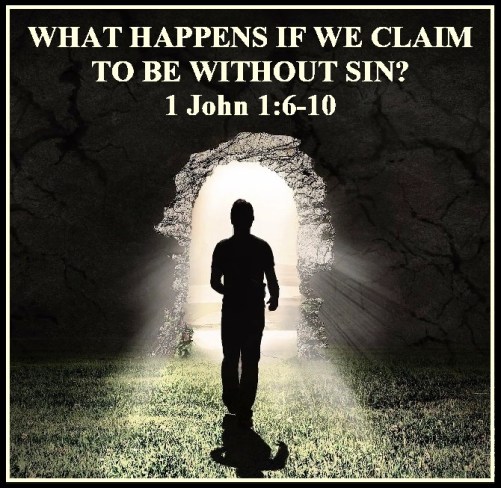
If we claim to have fellowship with Him and yet walk in the darkness, we lie and do not live out the truth. 7 But if we walk in the light, as He is in the light, we have fellowship with one another, and the blood of Jesus, his Son, purifies us from all sin. 8 If we claim to be without sin, we deceive ourselves and the truth is not in us. 9 If we confess our sins, He is faithful and just and will forgive us our sins and purify us from all unrighteousness. 10 If we claim we have not sinned, we make Him out to be a liar and His word is not in us. (1 John 1:6-10)
There are five such “if” statements in this passage. First, John refers to those who claim fellowship with Christ while living in sin (1 John 1:6). Second, John addresses those who truly live according to Christ’s commands (1 John 1:7). In verse 8, John refers to those who claim to have no sin whatsoever.
Saying we have no sin is considered negative and simply impossible, only God is without sin (Hebrews 4:15). So, anyone who claims to be without sin is self-deceived.
John teaches that those who claim to be without sin do not have the truth in them. This lack of truth applies to the saved believer who claims to have been freed from all sin in their present life. A believer should recognize his or her sinfulness and need of forgiveness through Christ. Even the most devout, clean-living Christian still contends with sin, in some way. Forgetting that we have sin makes us insensitive to things we ought to confess to God. However, as stated in verse 7, we don’t lose hope, but we trust in Christ to forgive us.
Verse 8 states that those who claim to be without sin are deceived (1 John 1:8). And in verse 9 we read that those who confess sins are reassured that God will forgive, and remove that sin’s impact on fellowship with Him. Note that even though this passage is written to believers, John states that those who confess sins are both forgiven and cleansed. Though believers are forgiven at the point of salvation, there is also an ongoing sense in which believers need to confess sin and experience forgiveness and cleansing. Cleansing of sin was an important part of the Mosaic Law, mentioned some 14 times in the book of Leviticus alone. It was the goal of those who brought a sacrifice to the Lord in the tabernacle and then in the temple.
Verse 10 adds two negative traits of those who claim to be without sin. First, it directly contradicts the word of God, which is the same as calling God a liar, which was and is considered a great blasphemy.
Second, this claim implies that the truth of the gospel is not in such a person. In other words, a person who claims to be without sin, at present, is not speaking the truth. A person who claims to have never sinned not only speaks a lie, but directly contradicts the gospel.
In John’s first epistle, he explains the fellowship we have with others and with Jesus Christ. He also gives descriptions of the genuine believer, one of them being that the believer sees a decreasing pattern of sin in his life (1 John 3:5–6; 5:18).
Here is what John says: “No one who lives in [Christ] keeps on sinning. No one who continues to sin has either seen Him or known Him” (1 John 3:6); and “We know that anyone born of God does not continue to sin; the One who was born of God keeps them safe, and the evil one cannot harm them” (1 John 5:18)
Some misunderstand these verses to mean that Christians can attain sinless perfection. After all, John says that “no one who lives in Him sins” (1 John 3:6) and that “no one who is born of God sins” (5:18). Based on these verses, many reason, sin must be a thing of the past and therefore, if you commit a sin, that’s proof that you are not saved, because Christians are sinless. But that is not what John is teaching.
We know that, when John writes that believers do not continue to sin, he is not referring to sinless perfection because of what he writes elsewhere in the same epistle. To believers John says, “If we claim to be without sin, we deceive ourselves and the truth is not in us” (1 John 1:8). Therefore, we are all sinners, and we continue to struggle with sin even after we are saved. We will never know a total absence of sin until we are with the Lord in glory: “When Christ appears, we shall be like him” (1 John 3:2).
If John is not referring to sinless perfection, what does he mean that believers do not continue to sin? Very simply, he means that believers will not continue practicing sin as a way of life. There will be a difference between the old life without Christ and the new life in Christ since “All who have this hope in [Christ] purify themselves, just as He is pure” (1 John 3:3).
As we are led by the Spirit, we will walk more and more in obedience to the Word of God. However, if a person claims to be a Christian but lives a life in defiance of God’s Word, then that person is showing the world they are unsaved. No one who continues to live in willful sin knows God. Because continual sin is incompatible with a new life in Christ, since living in adultery, homosexuality, idolatry, or falsehood is proof that no regenerative work of the Spirit has yet taken place in the heart, regardless of anyone’s claims to the contrary.
John gives us the reason why believers do not continue to sin: “No one who is born of God will continue to sin, because God’s seed remains in them; they cannot go on sinning, because they have been born of God” (1 John 3:9). A genuine Christian will not deliberately, knowingly, and habitually sin. It is not longer in their “spiritual DNA,” and when they do they immediately ask for forgiveness from God and those they have trespassed against.
We need to understand that as we read the pages of the New Testament, we discover that no New Testament Christian ever makes a claim to sinless perfection. The only one who could say, and did say, that he was without sin was the Lord Jesus himself. All others are reminded that though we must face constantly the challenge of walking without sin, nevertheless, the subtlety of the enemy, the cleverness of the wiles of the devil is so prevalent and powerful that there will be times when we fail.
As Paul warns his readers, “He who thinks he stands, take heed, lest he fall,” (1 Corinthians 10:12). This is why the Christian is always exhorted to walk in fear and trembling (Philippians 2:12) since he is fully aware of the ease with which he can fall into an attitude of mind that is contrary to the things of the Lord. He is aware of the fact that not until he has a redeemed body will he be totally free from sin. This is why our Lord Himself taught in Matthew 6:13 and Luke 11:4 to pray, “Lord, don’t let us yield to temptation, but rescue us from the evil one” – Amen!
*******



 Mission Venture Ministries
Leave a comment