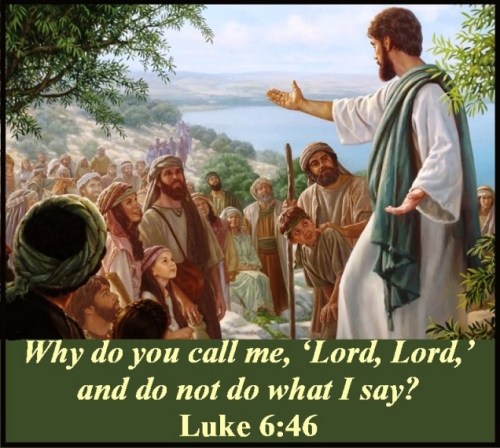
“Why do you call me, ‘Lord, Lord,’ and do not do what I say?” (Luke 6:46)
Obedience is an essential part of the Christian faith. Jesus Himself was “obedient unto death, even death on a cross” (Philippians 2:8). For Christians, the act of taking up our cross and following Christ (Matthew 16:24) means obedience. The Bible says that we show our love for Jesus by obeying Him in all things: “If you love Me, keep My commandments” (John 14:15). Consequently, a Christian who is not obeying Christ’s commands can rightly be asked, “Why do you call Jesus Lord, and don’t do what He says?”
Obedience is defined as “dutiful or submissive compliance to the commands of one in authority.” Using this definition, we see the elements of biblical obedience.
- “Dutiful” means it is our obligation to obey God, just as Jesus fulfilled His duty to the Father by dying on the cross for our sin.
- “Submissive compliance” indicates that we yield our wills to God’s in passive agreement without protest.
- “Commands” speaks of the Scriptures in which God has clearly delineated His instructions.
- “One in authority” is God Himself, whose authority is total and unequivocal.
For the Christian, obedience means complying with everything God has commanded – it is our duty to do so.
Having said this, it is important to remember that our obedience to God is not solely a matter of duty. We obey Him because we love Him (John 14:23). We also need to understand that the spirit of obedience is as important as the act of obedience. We serve the Lord in humility and love.
Another point to consider is that we must beware of using an appearance of obedience to mask a sinful heart. The Pharisees in Jesus’ time relentlessly pursued acts of obedience to the Law, but they became self-righteous, believing they deserved heaven because of what they had done. They considered themselves worthy before God, who owed them a reward; however, the Bible tells us that, without Christ, even our best, most righteous works are as “filthy rags” (Isaiah 64:6).
The Pharisees’ external obedience still lacked something, and Jesus exposed their heart attitude. Their hypocrisy in obeying the “letter of the law” while violating its spirit characterized their lives, and Jesus rebuked them sharply: “Woe to you, scribes and Pharisees, hypocrites! For you are like whitewashed tombs, which indeed appear beautiful outside, but inside they are full of dead men’s bones, and of all uncleanness. Even so you also appear righteous to men outwardly, but inside you are full of hypocrisy and iniquity” (Matthew 23:27–28).
The Pharisees were obedient in some respects, “But you have neglected the more important matters of the law-justice, mercy and faithfulness” (Matthew 23:23).
Today, we are not called to obey the Law of Moses since that has been fulfilled in Christ (Matthew 5:17). We are to obey the “law of Christ,” which is a law of love (Galatians 6:2; John 13:34). Jesus stated the greatest commands of all: “Love the Lord your God with all your heart and with all your soul, and with all your mind. This is the first and greatest commandment. And the second is like it: Love your neighbor as yourself. All the Law and the prophets hang on these two commandments” (Matthew 22:37–40).
If we love God, we will obey Him. We won’t be perfect in our obedience, but our desire is to submit to the Lord thru obedience and a reverent attitude. When we love God and obey Him, we naturally have love for one another. Obedience to God’s commands will make us light and salt in a dark and tasteless world (Matthew 5:13-16).
In saying, “Jesus is Lord,” we commit ourselves to obey Him since lordship is logically accompanied by a submission to Jesus’ authority, (Luke 6:46). If Jesus is Lord, then He owns us and has the right to tell us what to do.
Therefore, a person who says, “Jesus is Lord,” should have a full understanding of what that means since “no one can say, ‘Jesus is Lord,’ except by the Holy Spirit” (1 Corinthians 12:3), since faith in the Lord Jesus is required for salvation (Acts 16:31).
Someday, all will submit to that truth since: “God exalted Him to the highest place and gave Him the name that is above every name, that at the name of Jesus every knee should bow, in heaven and on earth and under the earth, and every tongue acknowledge that Jesus Christ is Lord, to the glory of God the Father” (Philippians 2:9-11).
As Jesus comes to the end of the sermon in which He has said some difficult things, He drives home the necessity of obeying what He has taught. He asks pointedly, “Why do you call Me, ‘Lord, Lord,’ and do not do what I say?” Then He concludes with His familiar parable of two men building separate houses.
The first lays a foundation on the rock, so that his house stands firm when the flood bursts against it. The second foolishly builds his house without the proper foundation, so that it is destroyed by the flood.
In the parable, the foundation is obedience to Christ’s teaching. The man who did not build on the foundation heard Jesus’ teaching. He agreed with it superficially, as seen by the fact that he calls Jesus “Lord.” But he did not obey Jesus’ teaching, resulting in tragic loss. Thus Jesus is showing us that obedience to Christ is not optional because it is at the very foundation of the Christian life.
Please remember that when we obey Christ, we receive an inner peace that is resistant to the challenges of the world. Even more, we receive an eternal peace with God that nothing can take away (Romans 8:38–39).
*******



Leave a comment