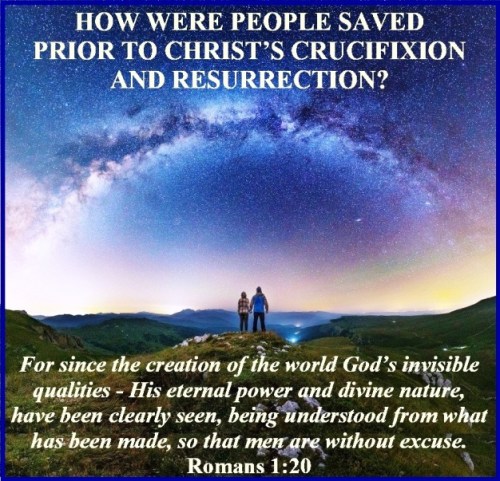
Since the fall of man, the basis of salvation has always been the death of Christ. No one, either prior to the cross or since the cross, would ever be saved without that one pivotal event in the history of the world. Christ’s death paid the penalty for past sins of Old Testament saints and future sins of New Testament saints.
People in the Old Testament times were saved by responding positively to God’s revelation. In other words, people were and are held accountable for what they know even those who have never heard of Jesus.
If someone lived in the Amazon jungle prior to Christ’s death and resurrection, how could they have been expected to believe in Jesus’ death and resurrection for the forgiveness of their sins? Obviously, they could not believe in something they had never heard. In fact, that’s what the Bible tells us: “How shall they believe in Him whom they have not heard?” (Romans 10:14).
We believe that God doesn’t expect people to respond to something they’ve never heard, and that He does hold us accountable for what we have heard. This idea is expressed by the following passage: “Sin is not taken into account when there is no law” (Romans 5:13). We know that at the root of it all we are made sinners because of Adam and not because we break the law ourselves. We know this because sin and death were in the world before the Law was ever given. The law was too late to prevent sin and death and it is too weak to save from sin and death.
If a person cannot respond to the good news of Jesus dying on their behalf (because they haven’t heard that good news), what are they accountable to respond to?
The Holy Scriptures tell us that there are fundamentals for every human being.
First, all people are accountable to know that God exists. “For since the creation of the world God’s invisible qualities — His eternal power and divine nature — have been clearly seen, being understood from what has been made, so that men are without excuse” (Romans 1:20). The complexity of the world around us tells us that there is a God, even though people can suppress that knowledge in their heart. Even those who haven’t heard of Jesus Christ are accountable for knowing that God exists.
Second, we are all accountable for knowing that we are sinners. The Old Testament law proves that we are sinful. Who has perfectly loved God or their neighbor? No one, therefore, “through the law we become conscious of sin” (Romans 3:20).
What about people who did not know the Old Testament law? The Bible tells us that even people who don’t have that law nonetheless have their own “law” meaning their own moral standard within their hearts. “Indeed, when Gentiles, who do not have the law, do by nature things required by the law, they are a law for themselves, even though they do not have the law. They show that the requirements of the law are written on their hearts, their consciences also bearing witness, and their thoughts sometimes accusing them and at other times even defending them” (Romans 2:14–15).
For example, if a person believes in their conscience that it is wrong to hurt or kill someone, then that is a law within their heart. Therefore, when they intentionally do these things, they have disobeyed the moral standard within their heart, thus proving they are a sinner.
So the two basics of revelation from God are:
- That God exists and
- That we humans are sinners.
How does one respond positively to these things? Well, since there is a God and we are sinners, then we need to humble ourselves before Him. Even the person who never hears about Jesus Christ is accountable for humbling himself before God. In fact, the Bible speaks of a future time when God will proclaim the “eternal gospel” to every nation, tribe, language, and people on Earth: “Fear God and give Him glory, because the hour of His judgment has come. Worship Him who made the heavens, the earth, the sea, and the springs of water” (Revelation 14:7).
In times past, prior to Jesus’ death and resurrection, people were saved by humbling themselves before God since God can have compassion and mercy on whomever He chooses “I will have mercy on whom I have mercy, and I will have compassion on whom I have compassion” (Romans 9:15), and God alone knows people’s hearts.
For those who don’t know or have not heard about Jesus, they still need to humble themselves before God. That means that they cannot trust in themselves for their salvation. Meaning, a person cannot think they can earn God’s favor by following religious rituals. That is an error because it’s like telling God, “I’m not a sinner, just look at all the good things I’ve done!” Therefore, it is a rejection of the basics of God’s revelation to us – that we are sinners who need forgiveness from God.
In short, we do not know who is saved and who is not since “The secret things belong to the Lord our God” (Deuteronomy 29:29). Certainly we cannot speak for any individual. However, as we have already seen, the Bible does not leave us totally in the dark and various approaches towards an answer can be made.
Throughout Scripture we know that God is a morally perfect and just. He also knows everything and His very nature is love. The idea that on the Day of Judgment there will be a massive failure of justice, either because God didn’t know or didn’t care is inconceivable. Such a God would be an evil tyrant, not the merciful Lord revealed by Jesus.
So whatever does happen would leave any honest observer entirely satisfied that the God of Creation has done right as seen in Genesis 18:25, “Far be it from You to do such a thing—to kill the righteous with the wicked, treating the righteous and the wicked alike. Far be it from You! Will not the Judge of all the earth do right?”
Again, no one is totally ignorant about the true and living God. “For since the creation of the world God’s invisible qualities – his eternal power and divine nature – have been clearly seen, being understood from what has been made, so that men are without excuse” (Romans 1:20). This includes the moral character of God as evidenced by our consciences. “For when Gentiles who do not have the Law instinctively perform the requirements of the Law, these, though not having the Law, are a law to themselves, in that they show the work of the Law written in their hearts, their conscience testifying and their thoughts alternately accusing or else defending them, on the day when, according to my gospel, God will judge the secrets of mankind through Christ Jesus.” (Romans 2:14-16).
The Old Testament heroes of faith had little knowledge of Jesus yet found God’s mercy. Jesus described Abraham, Isaac and Jacob as feasting in the kingdom of heaven (Matthew 8:11) while paradise itself is described as being at Abraham’s side (Luke 16:23). Christ’s sacrificial death on the cross hundreds of years later seems to have acted retrospectively for them (Romans 3:25, Hebrews 9:15). Is it not possible then for others who have not heard of Jesus to respond to the knowledge of God they do have in the way those heroes did?
Jesus promises that those who do seek after God will find Him (Matthew 7:7).
The requirement for salvation has always been faith. The object of one’s faith for salvation has always been God. The psalmist wrote, “Blessed are all who take refuge in Him” (Psalm 2:12). Genesis 15:6 tells us that Abraham believed God and that was enough for God to credit it to him for righteousness (Romans 4:3-8). The Old Testament sacrificial system did not take away sin, as Hebrews 10:1-10 clearly teaches. It did, however, point to the day when the Son of God would shed His blood for the sinful human race.
Everyone has enough knowledge of God in order to seek after Him but the general state is that men do not, even though their consciences condemn them. Hence we are called to proclaim the Gospel and urge that men and women be reconciled to God (2 Corinthians 5:20).
*******



Leave a comment