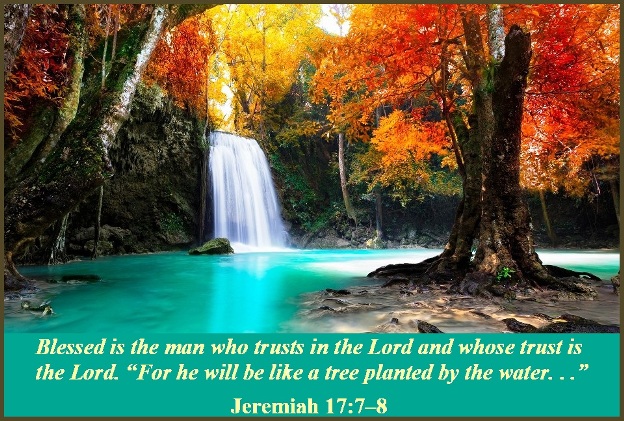
“Blessed is the man who trusts in the Lord and whose trust is the Lord. “For he will be like a tree planted by the water, that extends its roots by a stream and will not fear when the heat comes; but its leaves will be green, and it will not be anxious in a year of drought nor cease to yield fruit.” (Jeremiah 17:7–8)
“Trust and obey” captures a core biblical pattern as genuine faith shows itself in willing, obedient response to God’s word.
To trust God is to rely on His character, His wisdom, goodness, and promises, so that you rest your weight on Him rather than on your own understanding as Proverbs 3:5–6 teaches, “Trust in the Lord with all your heart and lean not on your own understanding; in all your ways submit to Him, and He will make your paths straight.”
It involves confidence that His commands are true and for our good, even when evidence seems contrary (Hebrews 11; Proverbs 3:5, Psalm37:3).
The key elements of trust being:
- Relying on God’s promises and character, not on our own understanding.
- Believing His word is true and acting from that settled confidence.
- A posture of inward surrender and dependence: “Trust in the Lord with all your heart.”
- We need to believe that God knows best and sees what we cannot while resting in His care instead of grasping for control.
To obey God is to submit to His will, complying with His commands and directions in concrete choices and habits. It is not bare external compliance but a responsive, loving obedience that flows from a relationship with Him. “If you love Me, keep My commands” (John 14:15). And as Jesus said: “Why do you call me, ‘Lord, Lord,’ and do not do what I say?” (Luke 6:46).
The key aspects of obeying are:
- Doing what He says in Scripture, even when costly.
- Following His leading in daily life (speech, moral values, relationships, mission).
- Persevering in doing good rather than answering evil with evil.
We need to understand that biblically, we cannot separate trust from obedience since real trust produces obedience, and real obedience springs from trust. When we trust in God’s goodness and sovereignty, obedience becomes an expression of love rather than mere duty.
In a practical way:
- Trust looks like “taking your hands off” outcomes and letting God be God.
- Obedience looks like doing the next right thing He has clearly commanded, even without seeing the full picture.
Together, trust and obedience are the path of joy and fellowship with Christ like the well know song: “Trust and obey, for there’s no other way to be happy in Jesus, but to trust and obey,” summarizes.
As we look at trust without obedience and obedience without trust we see that they are both distortions of biblical discipleship, but they fail in different ways.
Trust without obedience is where someone claims to “trust God” but does not submit their choices, habits, or moral values to His word. In Scripture this resembles “faith without works,” which James calls dead because it shows no real transformation.
So what are characteristics of trust without obedience?
- They are verbal or intellectual belief, but little concrete change in lifestyle.
- Confidence that “God will forgive” used to excuse ongoing disobedience (cheap grace).
- The result of a profession of faith that lacks credibility before others and stands under biblical warning: How we live reveals what we believe – “You shall know them by their fruits” (Matthew 7:16).
Now let us look at what obedience without trust reflects:
This is external compliance with God’s commands, but without real heart reliance on His character, grace, and promises. It easily becomes self‑reliant fearful rule‑keeping rather than loving response to a trusted Father.
And here are some of the characteristics of what obedience without trust reflects:
- Doing religious duties (church, giving, and serving) to earn favor or avoid punishment.
- Focusing on externals while the heart remains proud, anxious, or distant from God.
- A subtle hypocrisy where one teaches or enforces truth on others but does not rest in God oneself.
The result is what Paul and Jesus both confront – outward religion without inward obedience of faith, which ultimately dishonors God and burdens people.
Only trust in God motivates confident obedience in times of crisis, therefore, we should obey the Lord with our mind fixed on Him as His word teaches us: “You (God) will keep in perfect peace those whose minds are steadfast, because they trust in you” (Isaiah 26:3).
*******



Thank you for well writing and we are much beneficiaries of your good teachings. We continue to keep you in our prayers daily.
By: messengerchrist on January 28, 2026
at 10:12 am
You are most welcome brother, all honor and glory go to our heavenly Father. Blessings to you and your ministry.
By: missionventureministries on February 4, 2026
at 11:56 am
thank you, very good DR
Sent with Proton Mail secure email.
By: mvm707 on January 28, 2026
at 8:13 pm
God bless you.
By: missionventureministries on February 4, 2026
at 11:57 am