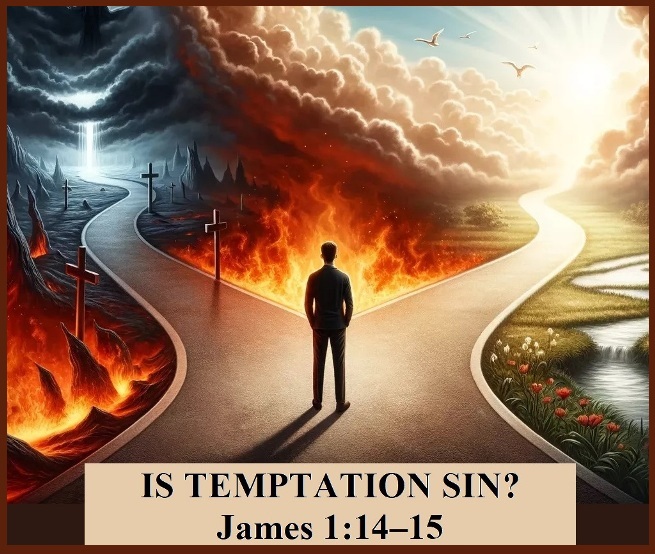
Temptation comes from our own desires, which entice us and drag us away. These desires give birth to sinful actions. And when sin is allowed to grow, it gives birth to death. (James 1:14–15)
Is temptation sin?
The Bible describes temptation as the pull or invitation toward disobeying God, while sin is actually choosing to go against God’s will. Temptation is universal and not automatically sinful, but if welcomed and consented to, it leads to sin and, ultimately, spiritual death.
One simple way to describe it is that temptation is the invitation to sin; while sin is accepting that invitation.
James tells us that temptation comes from being “dragged away” by our own desires; when desire is conceived, it “gives birth to sin,” and sin “brings forth death” (James 1:14–15)
Jesus was “tempted in every way as we are, yet without sin,” (Hebrews 4:15), showing that temptation itself is not sin.
In Matthew 6:13 Jesus teaches His disciples to distinguish between “forgive us our trespasses” (sin) from “keep us from falling into temptation” (testing/enticement), indicating they are not the same thing, but we have a responsibility to pay attention to the direction God is leading us and avoid temptation whenever we can.
These passages show a progression: desire → temptation → sin → death.
Let us take a look at how temptation differs from sin: Temptation can happen in your mind; sin happens through you when you consent.
Temptation is often sudden or external (a thought, a situation, an offer); sin begins when the heart embraces it, lingers on it, or acts on it.
Jesus experienced real temptation but never sinned, so being tempted cannot be the same as sin. Therefore, feeling tempted does not mean you have already failed; what matters is what you do with the temptation. The Bible calls believers to “endure” and “flee” temptation. For example, Joseph running from Potiphar’s wife, obeying God, rather than giving into her (Genesis 39:6–12).
Jesus resisted temptation in the wilderness by trusting His Father, relying on Scripture, and refusing every shortcut to glory that bypassed obedience and suffering. Christ resisted just as we are equipped to do, He stood on Scripture. Each time, Jesus responded Satan with “It is written,” (Matthew 4:1-11) showing that God’s Word, was His primary weapon.
Scripture shows that temptation is fought before the crisis arrives by knowing God’s Word and settling in advance that God’s way is best. In moments of testing, we follow Jesus’ pattern, identify the lie, answer it with truth from Scripture, and choose obedience even when it is costly to us.
When sin encroaches, we need to give a decisive NO and stand on the Word of God.
Remember that the thought of sin is not at all the same as an act of sin. It is when we act on tempting thoughts in a way that crosses the boundaries of God’s commands that we enter into sin. Temptation, by its very nature, makes a person feel bad because God’s moral law is written on the heart of every human being (Romans 1:20), and when a sinful temptation is introduced, our consciences immediately sense danger. However, the temptation itself is not the sin. Sin occurs when we mishandle temptation.
Therefore, “When tempted, no one should say, ‘God is tempting me.’ For God cannot be tempted by evil, nor does He tempt anyone; but each person is tempted when they are dragged away by their own evil desire and enticed” (James 1:13-14).
*******



Leave a comment