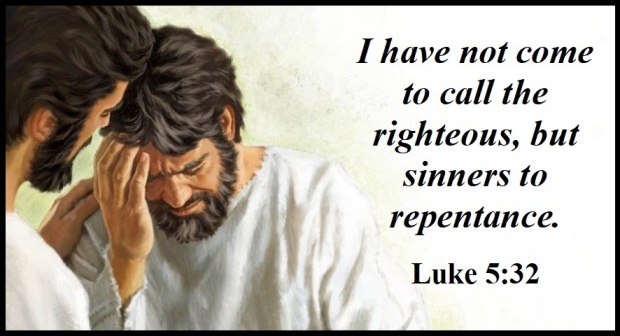
“I have not come to call the righteous, but sinners to repentance.” (Luke 5:32)
The very first recorded word of our Lord’s first sermon was (Matthew 4:17). He came to call sinners to repentance (Luke 5:32). After our Lord gave specific instructions to the apostles on how to evangelize, “they went out and preached men should repent” (Mark 6:12). His last sermon before ascending into heaven included a command to preach repentance for the forgiveness of sins (Luke 24:47). He also commanded the churches at Ephesus, Sardis and Pergamum to repent (Revelation 2:5, 16; 3:3). This leaves no doubt to the Savior’s position on repentance.
Peter also taught that repentance is necessary for salvation: “The Lord…is patient with you, not wanting anyone to perish, but everyone to come to repentance” (2 Peter 3:9). In his preaching ministry, Peter commanded his listeners to repent for the forgiveness and expiation of their sins (Acts 2:38, 3:19). On another occasion, when Simon the magician sinned by trying to buy God’s power with his money, Peter called him to “repent from his wickedness” (Acts 8:22). Paul also wrote: “God…commands all men everywhere to repent, because He has appointed a day on which He will judge the world in righteousness” (Acts 17:30-31).
The Greek word metanoia, translated as “repentance,” means a change of mind. When people are confronted with the truth of God’s Word, they must change their minds about God, sin, and themselves in order to trust Christ alone for salvation. Repentance is not a work that nullifies saving grace; it is the necessary turning that accompanies genuine faith. Such a turning is noted by Paul’s description of the Thessalonians: “You turned to God from idols to serve a living and true God” (1 Thessalonians 1:9). They turned from sinful behavior to the true God. Professing Christians who continue to live in habitual sin and think they are saved need to heed our Lord’s warning (Matthew 7:23).
Repentance is an important part of the Christian live since godly sorrow for sin leads to repentance since, “The sorrow that is according to the will of God produces a repentance without regret, leading to salvation” (2 Corinthians 7:10). It is God’s kindness that leads sinners to repentance, but a stubborn and unrepentant heart stores up His wrath for the Day of Judgment (Romans 2:4-5).
When convicted by the Holy Spirit, the sinner acknowledges his sinful nature, confesses his sins and makes a heartfelt plea for God’s forgiveness (Psalm 51:1-4; 1 John 1:9; Luke 18:13). A truly repentant person hates the sin he once loved, forsakes his wicked ways and turns to God (Isaiah 55:7; Acts 26:20). Repentance is ongoing in the life of believers and produces a desire to be victorious over sin by the Spirit’s power (Romans 8:13; 1 John 3:3). Tragically, the call to repentance is left out of many Gospel presentations and has resulted in an abundance of false converts in our churches (Matthew 7:21-23).
Repentance and faith are often described as two sides of the same coin, distinct yet inseparable. Both are gifts that our sovereign God grants at conversion (Acts 11:18; Ephesians 2:8–9; Philippians 1:29; 2 Timothy 2:24–25). Both will continue being present throughout the believer’s life (Romans 12:1–2; Hebrews 12:1–2).
Repentance is not only a change in mind, but it also leads to a changed heart and life (Isaiah 55:7; Acts 26:20). It sees sin as an affront to our holy God and Creator. The mind must be changed regarding sin because “the mind of sinful man is death, but the mind controlled by the Spirit is life” (Romans 8:6). Repentance produces a transformation of the will which will be evidenced by a change in direction and purpose (Romans 6:6, 12:2).
True conversions will be vindicated by works of repentance and obedience (Acts 26:20; Romans 6:17). God saves us the way we are, but He never leaves us the way we were (1 Thessalonians 4:3). Whenever God grants repentance, a vivid contrast is observed between the life that was once dominated by sin and the new life in Christ Jesus (Colossians 1:13; Titus 3:3-7; 1 Peter 4:1-4).
*******



 Mission Venture Ministries
Leave a comment