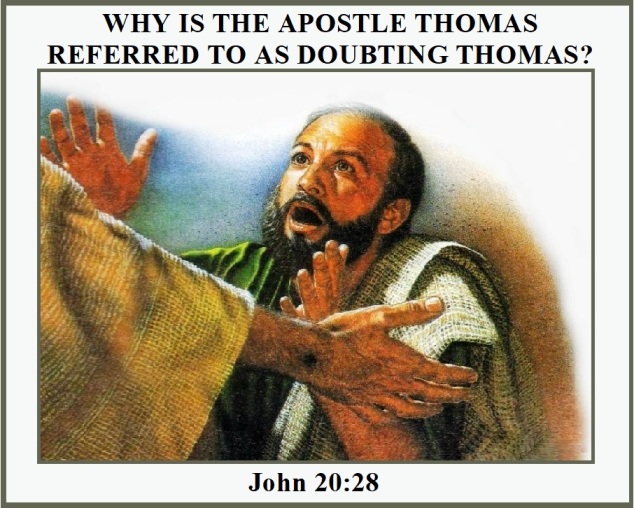
“And Thomas answered and said unto him, My LORD and my God.” (John 20:28)
Thomas has been called “doubting Thomas” because of his initial reluctance to believe in the Lord’s resurrection, but neither the Lord nor the other disciples ever viewed him in such a light. His later ministry as the first missionary/martyr to India speaks clearly of his great faith.
The Gospel of John gives us great insight into Thomas’s character. In John 11:1-16, word came to Jesus and His disciples that their friend Lazarus is sick in the town of Bethany, which sits just outside Jerusalem. And Jerusalem at that moment in history is the most dangerous place on earth for Jesus to go. The religious leaders there have already tried to stone him twice. The disciples know it. When Jesus announces that He intends to go back to Judea, the disciples push back in fear stating: “Rabbi, lately the Jews sought to stone You. And are You going there again?” (John 11:8).
They are terrified. Going to Bethany means walking straight into the hands of people who want Jesus dead and probably his followers along with him. And in that moment of fear, when the rest of the group is looking for a reason not to go, one voice cuts through and says the opposite. Then Thomas, who is called the twin, said to his fellow disciples, “Let us also go that we may die with Him” (John 11:16).
Later, in the upper room when Jesus spoke of going away, Thomas, still willing to go with Him anywhere, was the only one to ask, “Lord, we don’t know where you are going, so how can we know the way?” (John 14:5). Everyone in that room probably had the same question. But only Thomas was willing to raise his hand and confess that he did not understand. He would rather ask and look foolish than pretend and stay lost. And because he was brave enough to ask the honest question; Jesus gave one of the most important answers in all of scripture. “I am the way, the truth, and the life. No one comes to the Father except through Me” (John 14:6). One of the most quoted verses in the entire Bible exists because Thomas was honest enough to admit he was confused.
The honesty of Thomas became the doorway for one of the clearest statements Jesus ever made about who He is. So before we ever get to the upper room after the crucifixion and the famous “doubt,” we already know two things about this man. He was courageous enough to die and he was honest enough to ask. He did not hide his fear behind a brave face and he did not hide his confusion behind a nod.
Then, after the Lord had been crucified, “on the evening of that first day of the week, when the disciples were together, with the doors locked for fear of the Jewish leaders, Jesus came and stood among them and said, “Peace be with you!” (John 20:19). The point here is that they hid themselves in the upper room because they were fearful.
But Thomas was not there with them! The Scriptures do not say where he was when Jesus appeared in their midst, but he was not hiding there like the others. We are not told why, John simply records it in chapter 20:24. Now Thomas called the twin one of the twelve was not with them when Jesus came. But he (like the others) had failed to understand Jesus’ promise that He would rise again.
When the other disciples reported that they had seen the resurrected Lord, Thomas, realizing the tremendous significance of such a miracle if it were true, insisted he must see the proof firsthand. “Unless I see in his hands the print of the nails and put my finger into the print of the nails and put my hand into his side, I will not believe” (John 20:25).
Thomas is not asking for something that the other disciples had not already seen. He is asking to see exactly what the other 10 disciples had already seen; because Jesus had already shown them His hands and his side (John 20:20). The only difference was that he had not been in the room when it was presented. The other 10 had not believed based on the report of the women either. They believed when they saw the wounds with their own eyes.
Thomas was not refusing to believe in Jesus, he was refusing to believe in a secondhand account just like the others did not believe Mary Magdalene when she went to the disciples with the news: “I have seen the Lord!” And she told them that he had said these things to her” (John 20:18). Thomas had to see it for himself and as we will see, he had to wait 8 more days before that would take place.
From then on Thomas stayed close to the very people whose story he could not yet believe. Eight days later His disciples were in the house again, and Thomas was with them. Though the doors were locked, Jesus came and stood among them and said, “Peace be with you!” (John 20:26).
Jesus did not scold Thomas, instead, Jesus repeated Thomas’s own demand back to him, word for word and then offered to meet it completely. “Put your finger here; see My hands. Reach out your hand and put it into My side. Stop doubting and believe” (John 20:27).
In order to say those words, Jesus had to have known exactly what Thomas had demanded eight days earlier. Thomas had made his demand in a locked room to 10 other men when Jesus was not visibly present. And now the risen Christ repeats that private demand back to him phrase by phrase.
Jesus’ omnipresence had known his demand since he had spoken it. He did not come back to correct Thomas, but came back for Thomas. The Lord, newly risen from the grave, arranged an appearance and walked through a locked door specifically to answer one struggling man’s need to see for himself.
Jesus offers Thomas to reach out your hand and put it into My side. But the moment he was actually standing in front of the risen Christ, it seems he no longer needed to and he never did.
Instead when he saw the Lord, he showed a higher comprehension of what had taken place than any of the others, as he whispered in awe: “My LORD, and my God!” (John 20:28).
Then Jesus told him, “Because you have seen me, you have believed; blessed are those who have not seen and yet have believed” (John 20:29). Jesus is tenderly talking about us. He is saying there is a special blessing waiting for those who can trust without proof.
What scripture actually shows us about Thomas is a man who was brave enough to be willing to die, honest enough to ask, faithful enough to stay in the room, and hungry enough for the truth that he would not settle for a rumor of resurrection. He wanted the living Christ and he would not pretend he had found Him until he actually had.
Jesus who came back on the eighth day for one struggling man is not put off by our questions either. He is not looking for people who never wrestle. He is looking for people who are honest enough to bring their questions to Him. Thomas asked to see the wounds, and in the end, he did not even need to touch them. He just needed to be in the room when the Lord walked in. Maybe that is all your have ever been asking for. Not proof on demand, just the presence of the one you have been looking for the whole time. Remember that Jesus has a way of showing up even through locked doors, so keep the faith, keep trusting and keep praying and never loose hope.
*******



Leave a comment